

Comparing Home Insurance Deductible Options: What Works For You
Your home insurance deductible is one of the most important decisions you’ll make when protecting your Connecticut home. The deductible you choose directly impacts both your monthly premium and what you’ll pay out of pocket if you file a claim.
At Evaristo Insurance, we help homeowners understand their home insurance deductible options so they can make choices that fit their financial situation. This guide walks you through the trade-offs and shows you how to find the right balance for your needs.
Understanding Home Insurance Deductibles
What a Deductible Is and How It Works
A home insurance deductible is the amount you pay out of pocket before your insurance company covers the rest of a claim. When a covered loss occurs-whether it’s fire, theft, or storm damage-you pay your deductible first. If your home sustains $8,000 in damage and your deductible is $1,000, you pay $1,000 and the insurer covers the remaining $7,000. Connecticut homeowners typically choose fixed deductibles ranging from $500 to $5,000, though some policies use percentage-based deductibles instead. A percentage deductible is calculated as a percentage of your home’s insured value, commonly used for wind, hail, or hurricane damage. For example, if your home is insured for $300,000 and you have a 1% deductible, your out-of-pocket cost for a covered loss would be $3,000. Your policy may have different deductibles for different perils, so a hurricane loss might trigger a separate hurricane deductible while a fire loss uses your standard deductible.
How Deductibles Shape Your Premium
Your deductible directly controls what you pay monthly. The Connecticut average homeowners insurance premium sits around $1,575 per year according to NerdWallet data from November 2024, but this varies significantly based on your deductible choice. Raising your deductible typically lowers your annual premium, depending on your carrier and home’s risk profile. This trade-off means you save money upfront but accept higher out-of-pocket costs if you file a claim. Homeowners who want predictable costs after a loss and have strong emergency savings prefer lower deductibles ($250 to $750). Homeowners who can absorb unexpected expenses and prioritize monthly savings work best with higher deductibles ($2,500 to $5,000). Many Connecticut homeowners increase their deductibles over time as their financial situation improves, effectively locking in lower premiums. You can adjust your deductible at renewal or when updating your policy, which gives you flexibility as your circumstances change.
Understanding Connecticut’s Risk Landscape
Connecticut’s harsh winters create specific claim patterns that affect deductible decisions. Frozen pipes, ice dams, and snow damage are common winter losses covered under standard policies, so most homeowners face these risks regardless of location. Coastal Connecticut homeowners face additional hurricane and wind exposure, which often triggers separate percentage-based deductibles of your home’s value.
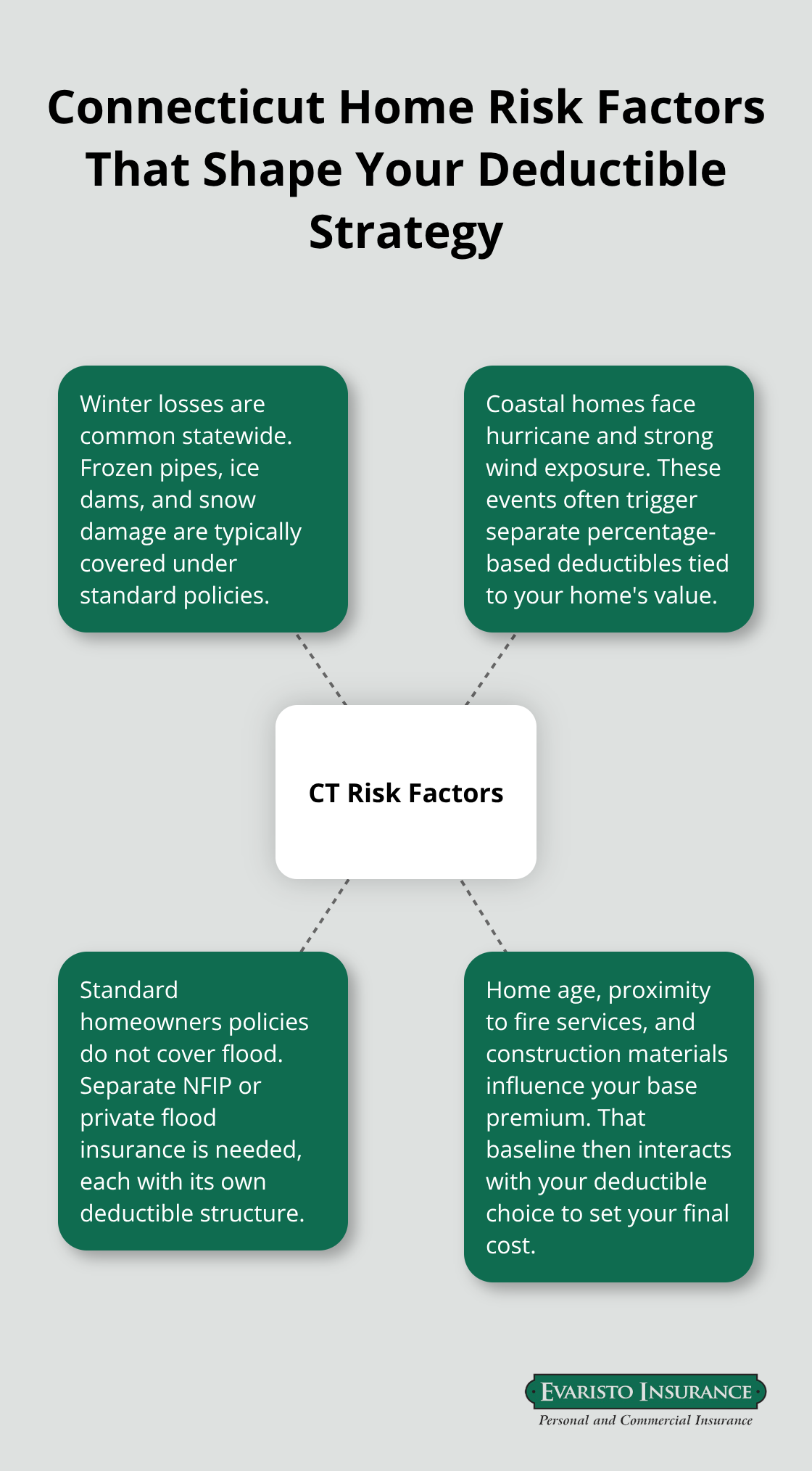
Flood damage is not covered by standard homeowners insurance in Connecticut, so if you live in a flood-prone area, you’ll need separate flood coverage through the National Flood Insurance Program or a private carrier (each with its own deductible structure). Your home’s age, location relative to fire stations, and construction materials all influence your premium base, which then interacts with your deductible choice to determine your final cost.
Now that you understand how deductibles work and the risks specific to Connecticut, the next step is evaluating which deductible option actually fits your financial situation and risk tolerance.
Comparing Your Deductible Trade-Offs
The Financial Trade-Off You Face
The deductible you select creates a direct financial trade-off that plays out over years. Lower deductibles mean higher monthly premiums but smaller out-of-pocket costs when you file a claim. Higher deductibles flip this equation-lower monthly premiums in exchange for absorbing more of the loss yourself. Connecticut homeowners need to understand where they actually stand financially before choosing. If you have $5,000 in accessible savings and face a $5,000 deductible, a single claim wipes out your emergency fund entirely. That’s a real problem, not a theoretical one. Conversely, choosing a $500 deductible when you could comfortably handle $2,500 means you overpay monthly for protection you don’t need.
How Much You Actually Save
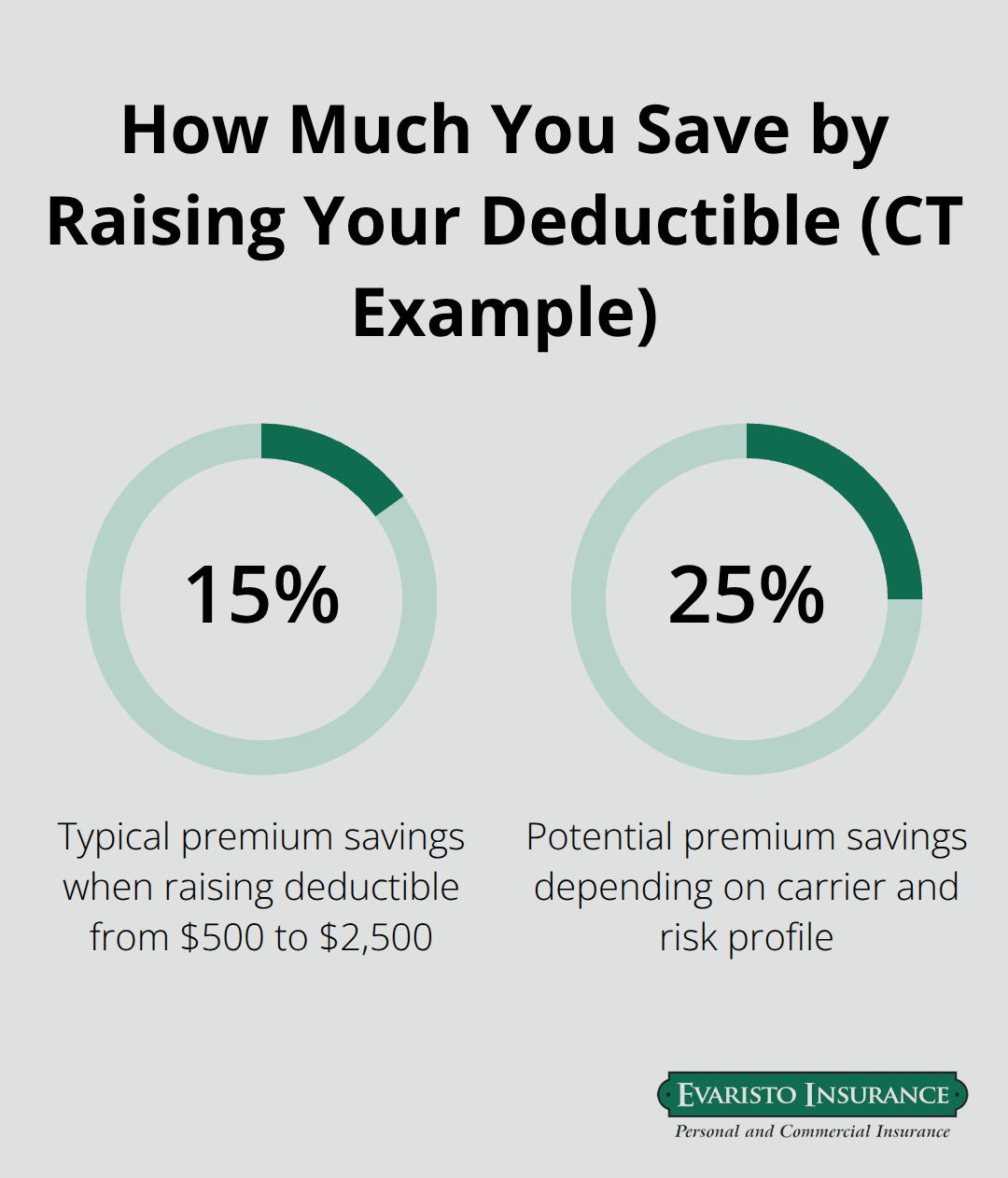
The Connecticut average premium of $1,575 per year masks significant variation based on deductible choice. Raising your deductible from $500 to $2,500 typically saves 15 to 25 percent on annual premiums, depending on your carrier and home’s risk profile. For a homeowner paying $1,575 yearly, that translates to potentially $236 to $394 in annual savings-money that compounds over time.
The catch is simple: you must have liquid savings to cover that higher deductible without borrowing or going into credit card debt.
Your Connecticut Risk Profile Matters More Than You Think
Your actual risk exposure in Connecticut should shape your deductible strategy more than most homeowners realize. Coastal properties facing hurricane exposure often carry separate percentage-based deductibles that can reach $7,000 or more on a $350,000 home insured value. An inland home in Hartford County with minimal flood risk and standard winter exposure looks completely different. If you’ve filed zero claims in ten years and your home is newer with updated systems, a higher deductible makes financial sense. If you’ve experienced frozen pipe damage, roof leaks, or theft within the past five years, your risk profile suggests lower deductibles deserve serious consideration.
Bundling and Flexibility Work in Your Favor
Bundling home and auto insurance with the same carrier can yield approximately $950 in combined savings according to industry data, which sometimes makes absorbing a higher deductible more palatable when your total insurance costs drop substantially. Connecticut homeowners who increase deductibles over time as their financial cushion grows demonstrate the smartest approach-starting conservative when finances are tight, then adjusting upward as circumstances improve. You can modify your deductible at renewal without penalty, giving you the flexibility to recalibrate as your emergency fund grows or your home’s condition changes. This adaptability means your deductible choice today doesn’t lock you into a permanent decision.
Understanding your financial capacity and risk exposure sets the foundation for the next critical step: actually selecting the home insurance deductible amount that protects your home without overextending your budget.
Choosing the Right Deductible for Your Home
Assess Your Emergency Fund First
Your emergency fund is the single most important factor in choosing a deductible, yet most Connecticut homeowners skip this calculation entirely. Start with what you actually have in accessible savings right now-not retirement accounts or home equity, but cash you can reach within days. If you have $3,000 in savings and choose a $2,500 deductible, a single claim leaves you with almost nothing. That’s a dangerous position. Conversely, if you have $15,000 in liquid savings and monthly cash flow to handle unexpected expenses, a $2,500 deductible makes financial sense.
The practical rule is straightforward: your deductible should never exceed 50 percent of your accessible emergency fund. If you have $5,000 saved, cap your deductible at $2,500. If you have $10,000, you can comfortably handle up to $5,000. This isn’t conservative thinking-it’s realistic protection.
Evaluate Your Location and Risk Exposure
Your location and claims history tell you what risks actually threaten your home. Coastal Connecticut properties face hurricane and wind exposure that inland homes simply don’t encounter, which means your percentage-based hurricane deductible could reach $7,000 or higher on a $350,000 insured value-a number that demands substantial savings backup. Inland homes in areas like Hartford or Tolland County with standard winter exposure and minimal flood risk operate under completely different financial constraints.
Review what you’ve actually claimed in the past five years: if you filed claims for frozen pipes, roof leaks, or theft, your home signals higher-than-average loss frequency, which means lower deductibles protect your finances better despite higher premiums. If you haven’t filed a single claim and your home received a new roof or updated plumbing within the past three years, your actual risk profile supports higher deductibles.
Build Your Deductible Strategy Over Time
Connecticut homeowners who increased deductibles gradually as their financial situation improved demonstrated the smartest strategy-starting with $500 to $1,000 when finances were tight, then moving to $2,500 as emergency savings grew. This approach aligns your coverage with your genuine financial capacity at each stage rather than forcing an uncomfortable choice upfront.
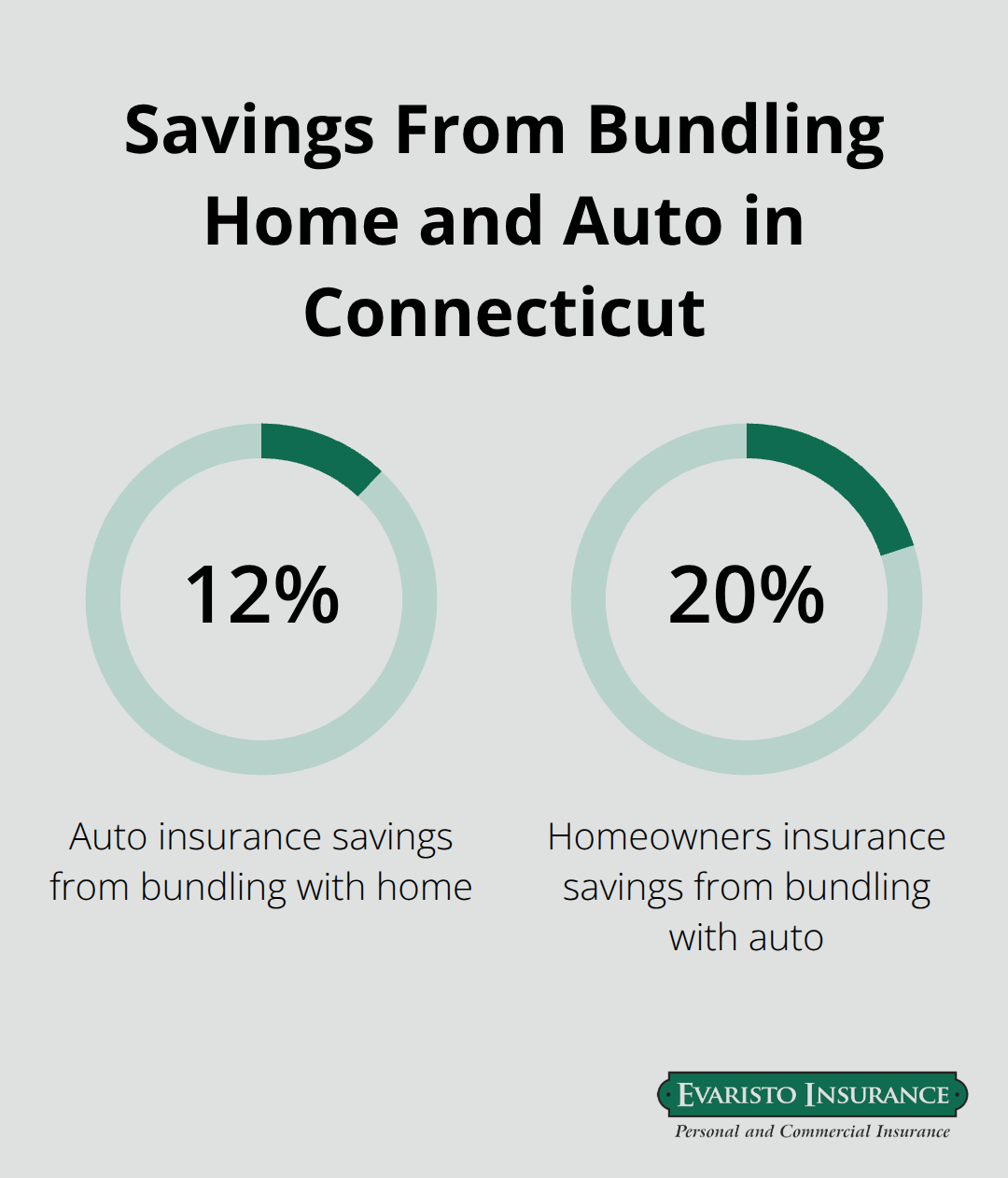
Bundling home and auto insurance with the same carrier can yield savings of up to 12% on auto insurance and up to 20% on homeowners insurance, which sometimes frees up monthly cash flow to build emergency reserves and support higher deductibles over time. You can modify your deductible at renewal without penalty, giving you the flexibility to recalibrate as your emergency fund grows or your home’s condition changes.
Compare Quotes Across Multiple Carriers
Get quotes from multiple carriers with different deductible amounts to see your actual premium savings, then match that number against your emergency fund and monthly surplus to find the deductible that protects both your home and your finances. This comparison reveals how much you actually save at each deductible level rather than relying on general industry averages that may not apply to your specific situation.
Final Thoughts
Your home insurance deductible choice reflects your financial reality, not industry averages or what your neighbor selected. The deductible you pick today should align with what you can actually afford to pay out of pocket, your home’s specific risk exposure in Connecticut, and your ability to rebuild emergency savings after a claim. Connecticut homeowners who matched their deductible to their genuine financial capacity felt confident about their coverage rather than anxious about potential out-of-pocket costs.
Getting quotes from multiple carriers with different deductible amounts reveals your actual savings at each level rather than relying on general estimates. You’ll see exactly how much you save by raising your deductible from $1,000 to $2,500, then decide whether that monthly savings justifies the higher out-of-pocket risk. This comparison against your emergency fund and monthly cash flow shows you the real trade-off between premium savings and financial exposure.
Contact Evaristo Insurance to discuss your home insurance deductible options with an agent who knows Connecticut homeowners’ actual needs. As a second-generation, family-owned independent agency serving Connecticut since 1989, we compare options across different insurers to find coverage that matches your financial goals and protects your home against Connecticut’s specific risks. Your deductible decision deserves expertise grounded in local experience, not generic online quotes.
Disclaimer: This blog post is for general informational purposes only and does not represent actual coverage, policy terms, or legal requirements. Insurance details vary by individual and jurisdiction. Please consult a licensed insurance professional for advice specific to your situation.

