

Auto Insurance Deductibles Explained: How To Choose Your Level
Your auto insurance deductible is one of the most misunderstood parts of your policy. Many Connecticut drivers either pick a number without thinking or choose based on what a friend paid, which often leads to overpaying or being underprotected.
At Evaristo Insurance, we’ve helped hundreds of local drivers understand auto insurance deductibles explained in plain terms. The right deductible balances your monthly premium with what you can actually afford to pay if an accident happens.
What Your Deductible Really Means
How Deductibles Work
Your deductible is the amount you pay out of your own pocket when you file a claim. If you’re in a collision and your repair bill is $5,000 with a $500 deductible, you pay $500 and your insurance covers the remaining $4,500. This straightforward arrangement shapes every decision you make about your coverage.
Common Deductible Amounts in Connecticut
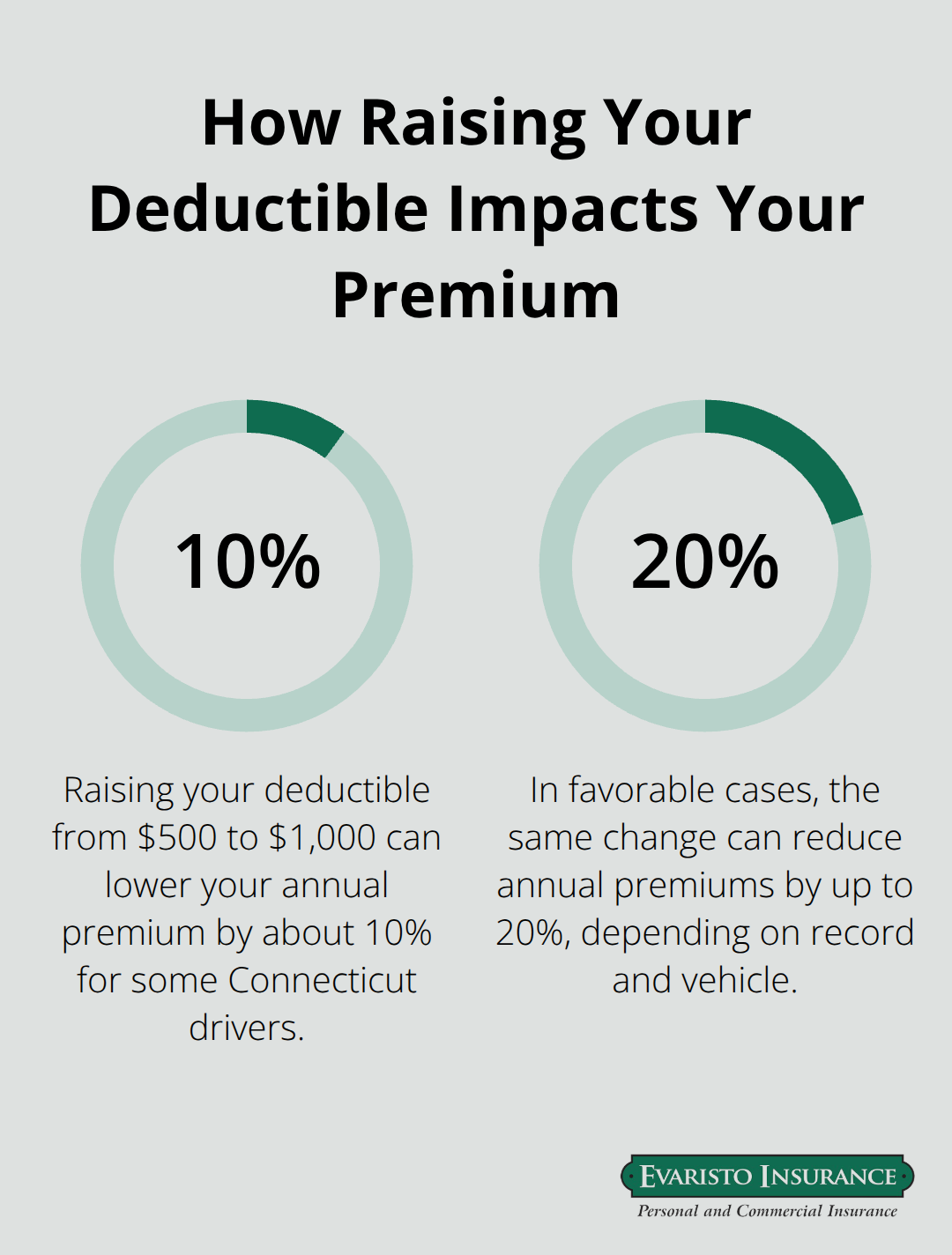
Connecticut drivers typically choose between $250, $500, $750, and $1,000 deductibles, though some carriers offer options as low as $100 or as high as $2,500. The relationship between your deductible and your premium is direct and measurable: raising your deductible from $500 to $1,000 can reduce your annual premium by 10 to 20 percent, depending on your driving record and vehicle. This trade-off exists because higher deductibles mean the insurance company pays less when accidents happen, so they reward you with lower monthly costs.
The Real Cost of Your Choice
The key insight most drivers miss is that this isn’t just about saving money on premiums-it’s about what you can realistically afford to pay if an accident occurs tomorrow. Connecticut’s insurance market shows that most drivers underestimate how often they’ll actually use their deductible. According to the National Highway Traffic Safety Administration, the average driver will file a comprehensive or collision claim once every 17.9 years, which means many Connecticut drivers with $500 deductibles will go their entire driving lifetime without needing to pay it.
When Higher Deductibles Backfire
However, if you live in Hartford or Bridgeport where accident rates run higher, or if you drive a vehicle worth less than $10,000, a higher deductible becomes riskier because the repair costs might not justify the premium savings. A driver with a 2015 Honda Civic worth approximately $8,000 might find that a $1,000 deductible saves $300 annually but leaves them paying 12.5 percent of their vehicle’s value out of pocket for any accident. Your actual financial cushion matters far more than what sounds reasonable in theory-and that’s where the next section helps you calculate what truly works for your situation.
Factors to Consider When Choosing Your Deductible
Your Emergency Fund Determines What You Can Actually Afford
Your emergency fund is the single most important factor in choosing your deductible, and most Connecticut drivers get this wrong. If you have less than $1,000 in savings, a $1,000 deductible is financially dangerous, period.
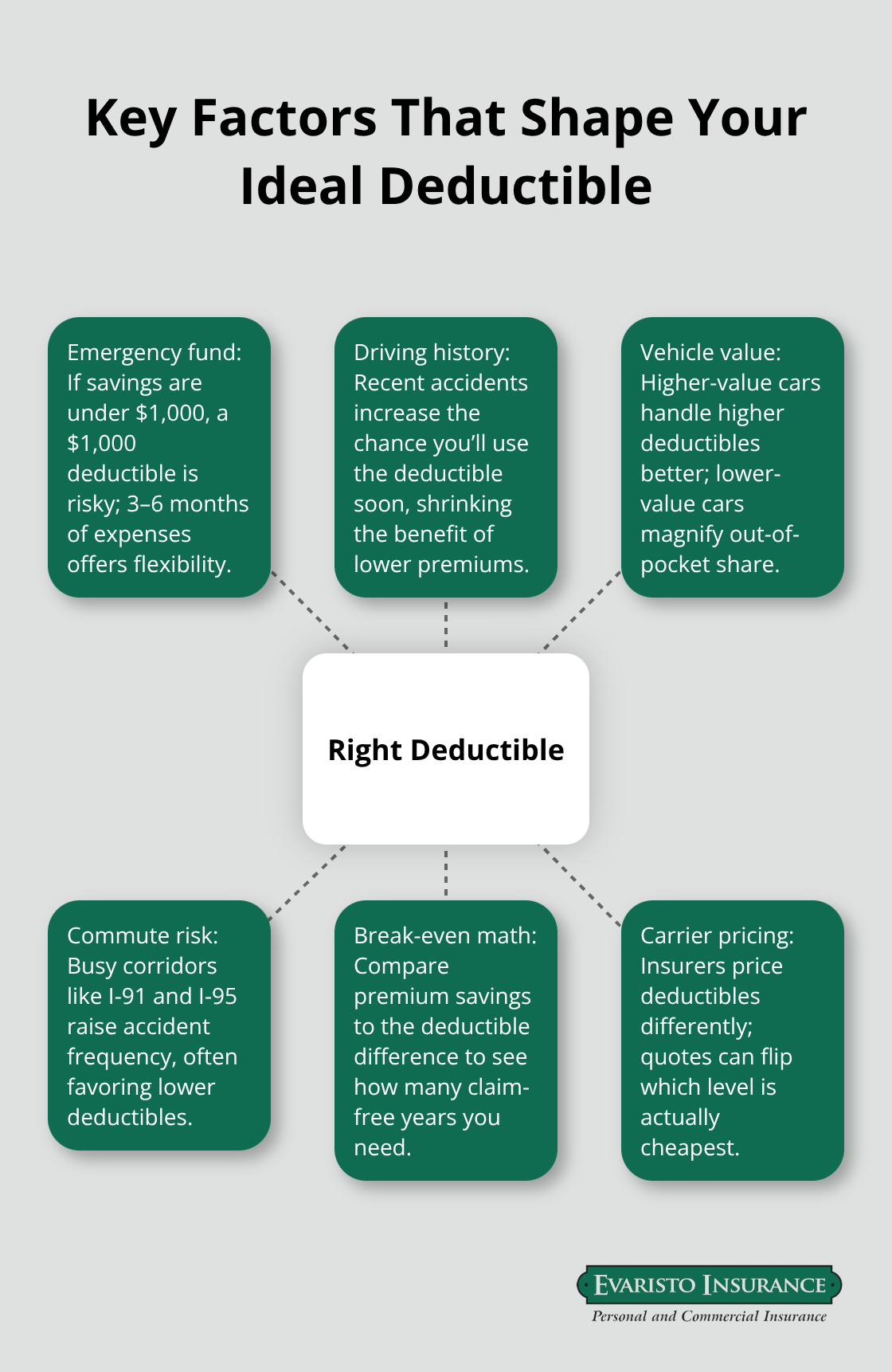
The Federal Reserve reports that 47 to 59 percent of American adults have at least three months of emergency savings, which means a significant portion of Connecticut drivers are choosing deductibles they cannot actually afford to pay. A $500 deductible paired with a modest emergency fund works far better than a $1,000 deductible that forces you into credit card debt when an accident happens. Once you have three to six months of expenses saved, you can comfortably handle a higher deductible and capture those premium savings.
Your Driving History Reveals Your Real Risk Level
Your driving history and the actual value of your vehicle work together to determine whether a high deductible makes financial sense. If you’ve had two accidents in the last five years, a $1,000 deductible works against you because statistically you’re more likely to use it, which means you’ll pay higher out-of-pocket costs for the sake of a lower premium. Connecticut drivers with clean records and newer vehicles worth $15,000 or more can absorb a $1,000 deductible without stress, but a driver with an older car worth $6,000 faces a different calculation entirely.
The Math Changes Based on Your Vehicle’s Value
A $1,000 deductible on a $6,000 vehicle represents 16.7 percent of your car’s value, which is substantial. That same $1,000 deductible on a $20,000 vehicle represents only 5 percent of its value (a much more manageable proportion). The math shifts dramatically based on what you’re protecting. A driver with an older vehicle and limited savings should try a $500 deductible, while someone with a newer car and solid emergency reserves can comfortably handle $750 or $1,000. Your actual financial situation and driving patterns matter far more than what sounds reasonable in theory-and that’s where calculating your break-even point helps you make the right choice.
How to Find the Right Deductible for Your Needs
Calculate Your Break-Even Point
The most practical way to choose your deductible is to calculate where your premium savings stop making financial sense. Start by getting quotes from your current carrier for three deductible levels: $500, $750, and $1,000. Write down the annual premium for each option, then subtract to find your actual savings.
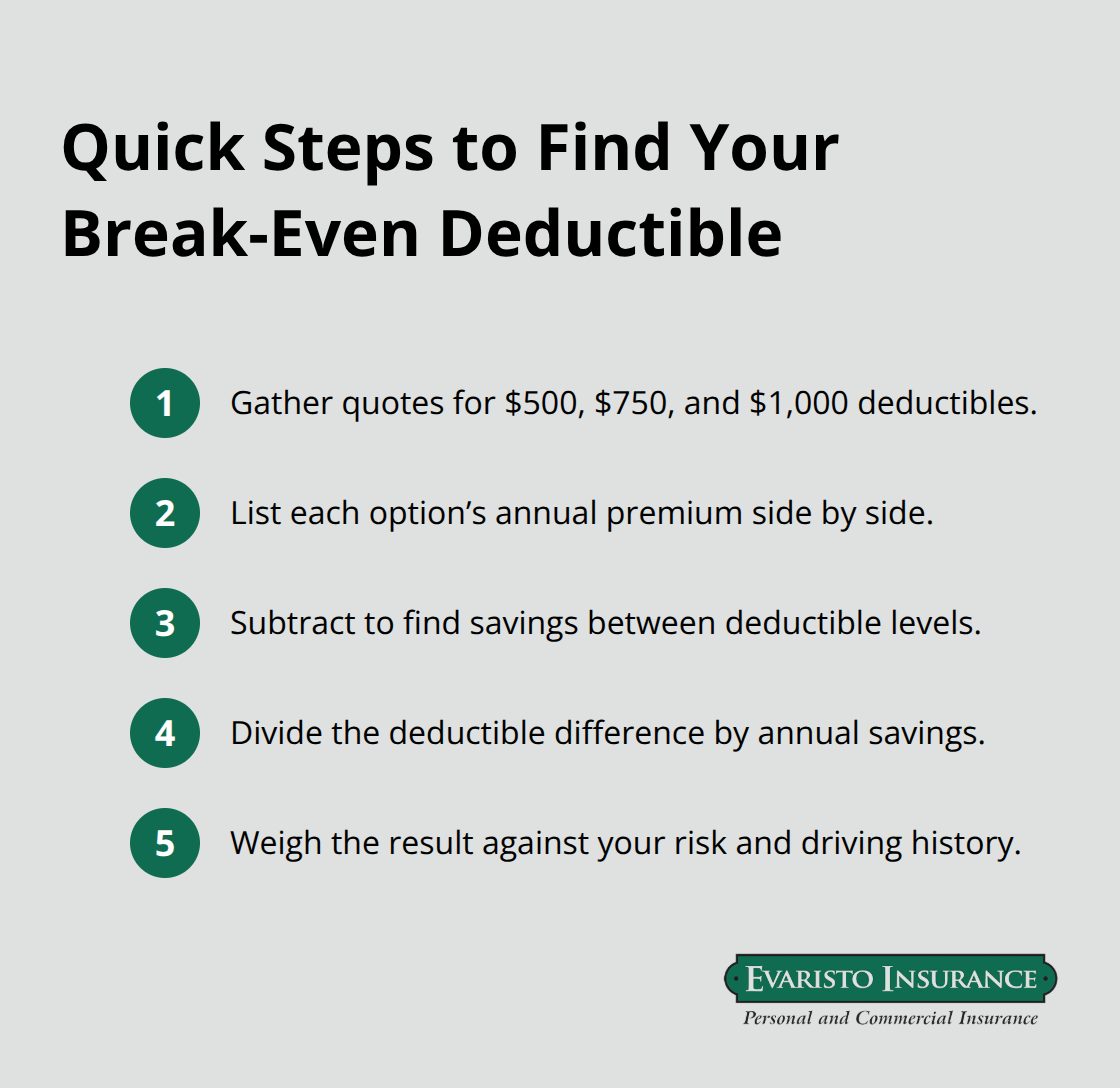
Use this formula: Break-Even (in years) = Difference in Deductibles ÷ Annual Premium Savings. If moving from $500 to $1,000 saves you $200 per year, you need to go five years without filing a claim to break even on that decision. If you’ve had an accident in the last five years or live in a high-traffic area of Connecticut, that five-year window becomes unrealistic, which means the $500 deductible protects your wallet better. Connecticut drivers who commute on I-91 or I-95 should weight this calculation more heavily toward lower deductibles because accident frequency in those corridors runs higher than rural areas.
Compare Your Real Premium Savings
Most Connecticut drivers underestimate how much premium difference actually exists between deductible levels. A 35-year-old driver with a clean record might see a $150 to $250 annual difference between a $500 and $1,000 deductible, while a driver with an accident on record might see only $75 to $125 in savings. That smaller gap changes everything about the decision because the financial benefit shrinks while your out-of-pocket risk stays the same. Request quotes that show the exact premium for each deductible option, not just percentages, so you can see real dollars. Many Connecticut drivers jump to $1,000 deductibles chasing a 15 percent premium discount that turns into only $120 annually on an $8,000 policy, which hardly justifies the risk if an accident happens. Multiple carriers price deductibles differently, and a $1,000 deductible with one carrier might cost just as much as a $750 deductible with another. Getting multiple quotes takes 20 minutes and often reveals that your current carrier isn’t pricing your deductible level competitively.
Work Through Your Specific Situation
Your final deductible choice should come from a conversation with someone who understands your actual driving patterns and financial position, not from an online calculator or a generic recommendation. A local agent can review your claims history, see what you drive, and understand whether you’re financially prepared for a higher deductible. An agent working with multiple carriers can also show you whether paying a slightly higher premium for a lower deductible makes sense given your vehicle’s age or your emergency fund situation. If you drive a 2018 vehicle worth $14,000 and have $8,000 in emergency savings, a $750 deductible strikes the right balance, but that exact answer changes if you drive a 2012 vehicle worth $6,000 instead (the math shifts dramatically based on what you’re protecting). Your deductible choice isn’t something to decide alone or based on what your neighbor chose, which is why talking with someone who knows Connecticut’s insurance market and your personal situation produces better results than going it alone.
Final Thoughts
Your deductible choice reflects three concrete realities: what you can afford to pay, how often you actually drive in high-risk situations, and what your vehicle is worth. A $500 deductible protects Connecticut drivers with limited emergency savings or older vehicles, while a $1,000 deductible makes sense for drivers with solid financial cushions and newer cars. The break-even calculation shows you exactly how many years you need to avoid accidents to justify a higher deductible, and that number often reveals whether the premium savings justify the risk.
We at Evaristo Insurance have spent over three decades helping Connecticut drivers navigate these decisions with auto insurance deductibles explained in terms that actually matter. Our local agents understand the specific risks on I-91 and I-95, know how Hartford and Bridgeport accident rates affect your coverage needs, and can show you real quotes from multiple carriers so you see actual dollar differences between deductible levels. We compare top carriers to find you competitive pricing paired with the right deductible for your circumstances.
Your current policy might not reflect your actual financial situation or driving patterns anymore (life changes, vehicles age, and emergency funds grow or shrink). Contact Evaristo Insurance at either our Ellington or West Hartford office to discuss whether your current deductible still makes sense. A 20-minute conversation often reveals that a small adjustment to your deductible saves you money while actually improving your protection.
Disclaimer: This blog post is for general informational purposes only and does not represent actual coverage, policy terms, or legal requirements. Insurance details vary by individual and jurisdiction. Please consult a licensed insurance professional for advice specific to your situation.

