

Uninsured Motorist Coverage Importance: Protecting You on the Road
Every day, Connecticut drivers share the road with uninsured motorists. If you’re hit by someone without insurance, your own coverage becomes your financial lifeline.
Understanding uninsured motorist coverage importance isn’t optional-it’s a practical necessity. We at Evaristo Insurance help Connecticut drivers build protection that actually covers them when it matters most.
What Uninsured Motorist Coverage Actually Does
How This Coverage Protects You
Uninsured motorist coverage pays your medical expenses, lost wages, and other damages when a driver without insurance causes your crash. This isn’t theoretical protection-it’s the difference between absorbing thousands in medical bills yourself or having your policy cover them. Connecticut requires you to carry uninsured motorist coverage unless you actively reject it in writing, which means most drivers already have it but don’t fully understand what it covers. The coverage applies to your injuries, not property damage to your vehicle; if you need to repair your car after hitting an uninsured driver, you’d use collision coverage instead.
The Underinsured Motorist Distinction
Underinsured motorist coverage works similarly but activates when the at-fault driver’s liability limits fall short of your actual damages-a critical distinction because many drivers carry minimal coverage that won’t cover serious injuries. Setting your uninsured motorist limits equal to or higher than your bodily injury liability limits prevents protection gaps, and this matters especially in Connecticut where congested highways like I-95 and major urban corridors in Bridgeport, Stamford, New Haven, and Hartford increase your odds of encountering uninsured motorists daily.
Connecticut’s Traffic Exposure
Connecticut’s traffic patterns create real exposure to uninsured drivers. The state’s dense population, high-traffic corridors connecting to the New York City metropolitan area, and major attractions like Foxwoods and Mohegan Sun casinos mean you constantly share roads with drivers whose insurance status you can’t verify. Seasonal weather challenges and occasional severe storms add crash risk year-round.
How Claims Work in Practice
When you’re injured in a crash with an uninsured driver, your uninsured motorist coverage handles your claim through your own insurer, which then attempts recovery from the at-fault driver-you don’t negotiate directly with someone who likely has no assets to recover anyway. This coverage becomes your financial protection when the other party can’t pay. Understanding your specific limits and how they interact with your other coverages sets the foundation for making informed decisions about the protection level you actually need.
Why Uninsured Motorists Create Real Financial Threats in Connecticut
The numbers paint a clear picture of Connecticut roads. In 2024, approximately 26.7 million Americans under age 65 lacked health insurance, with uninsured rates highest among Hispanic drivers (18.4%) and American Indian/Alaska Native drivers (18.9%). Connecticut’s Medicaid expansion keeps the state’s uninsured rate lower than non-expansion states, yet you still encounter uninsured motorists daily on I-95, I-84, and I-91. The state’s dense population of 3.69 million people concentrated across major corridors like Bridgeport, Stamford, New Haven, and Hartford creates constant collision exposure. The state’s median household income of $91,700 masks significant inequality-the Gini coefficient sits at 0.50-which means drivers in lower-income areas struggle to afford insurance while still needing to drive for work. When an uninsured driver hits you, their financial situation becomes your problem unless your uninsured motorist coverage absorbs the cost.
What Happens When an Uninsured Driver Hits You
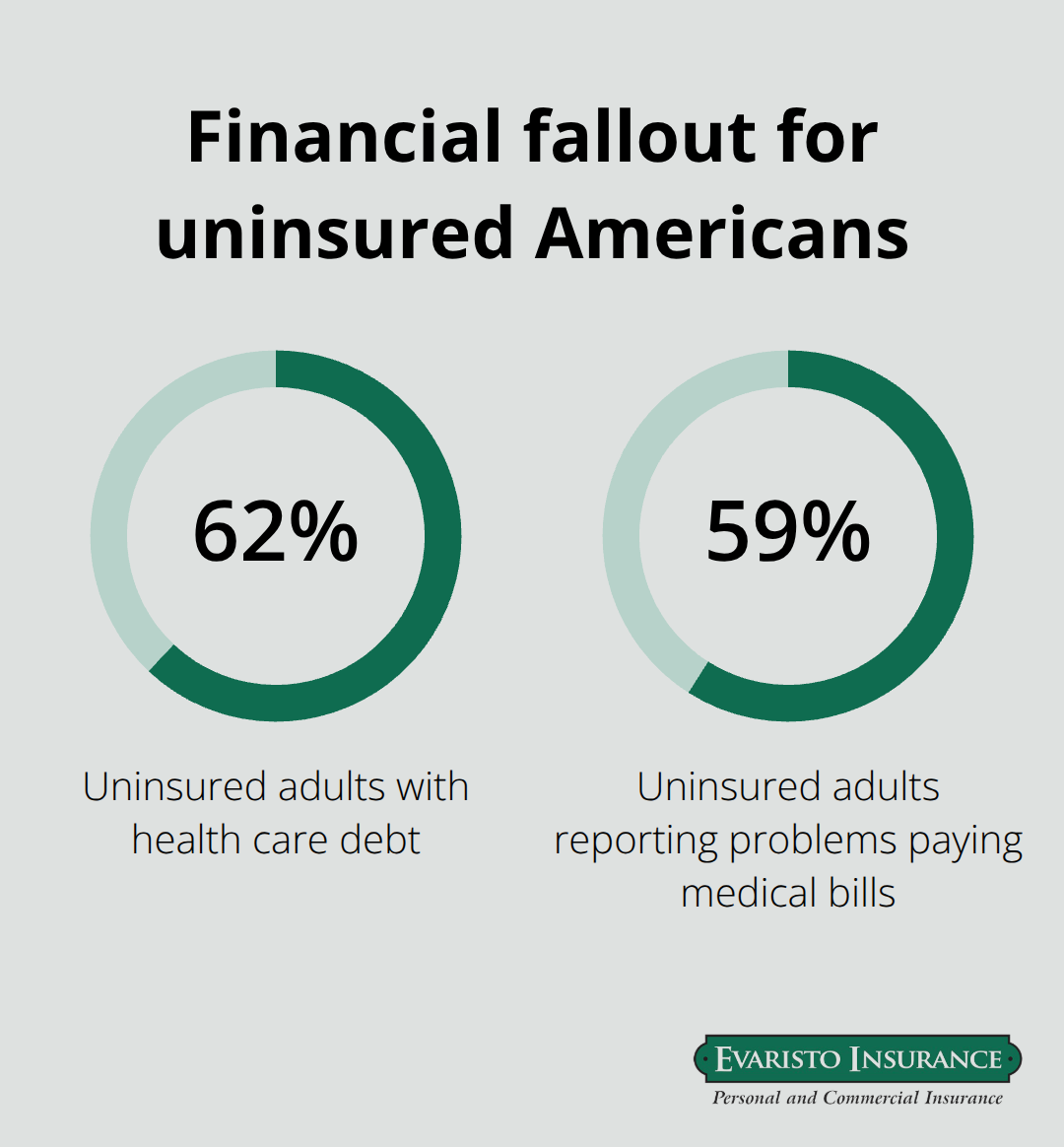
A typical scenario unfolds on I-95 near New Haven during rush hour: an uninsured driver rear-ends your vehicle, you sustain soft tissue injuries that require physical therapy, you miss two weeks of work, and medical bills reach $8,000. The at-fault driver admits fault but carries no insurance. Without uninsured motorist coverage, you file a personal injury lawsuit against someone with no assets, spending months in court for a judgment you’ll never collect. With uninsured motorist coverage set at $25,000 per person/$50,000 per accident, your claim processes within weeks-your medical expenses get paid, your lost wages covered, and you avoid the debt spiral that traps accident victims. Research from the Kaiser Family Foundation shows that 62% of uninsured adults carry health care debt, and 59% report problems paying medical bills. An accident without proper coverage accelerates this financial deterioration.
Medical Costs Escalate Quickly After a Crash
Medical expenses after a crash climb fast. Emergency room visits alone cost $1,200 to $2,500 depending on injury severity. Add imaging, follow-up appointments, and potential physical therapy, and you surpass $5,000 for minor injuries. Serious injuries involving hospitalization or surgery reach $50,000 or more.
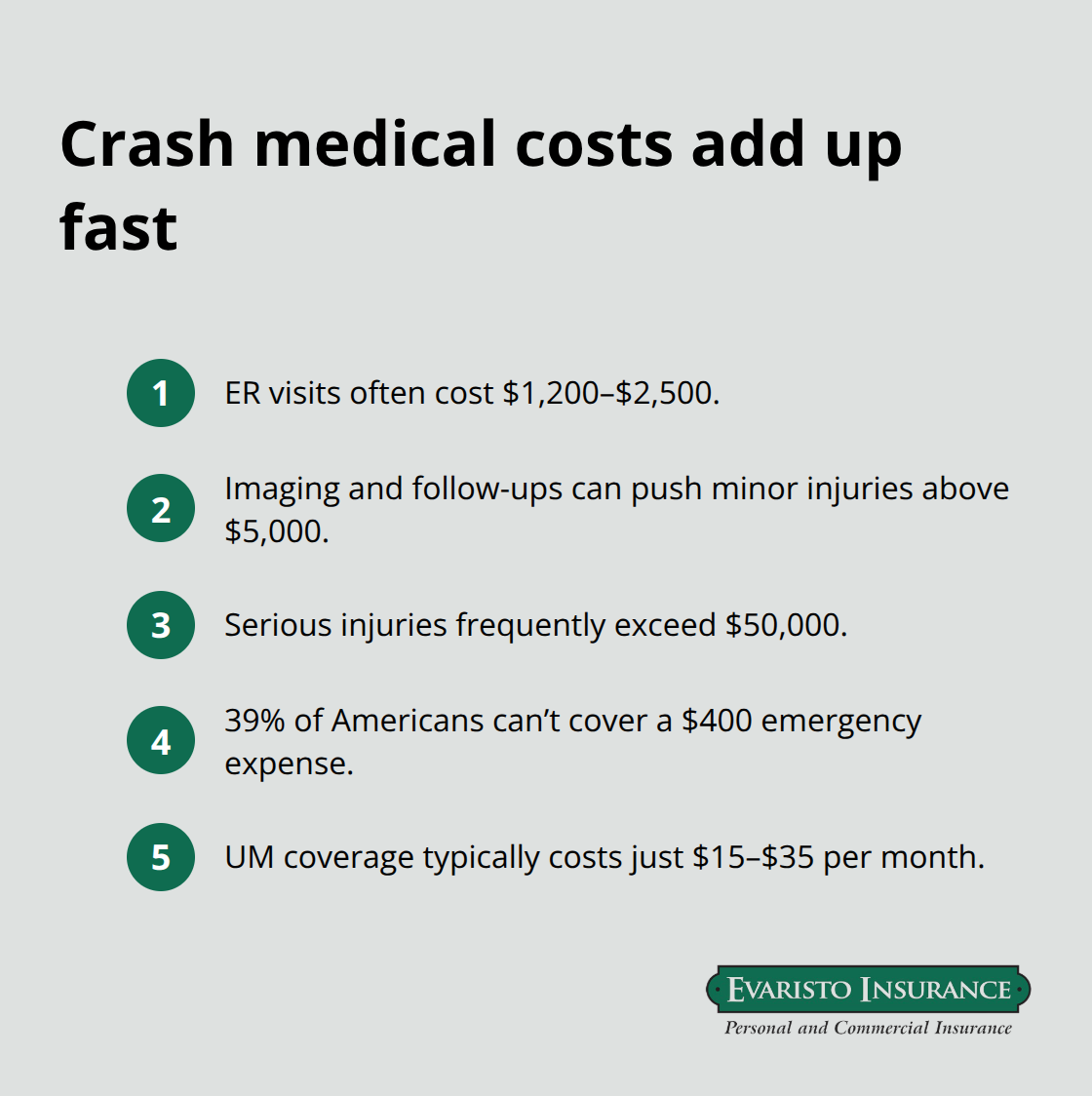
Connecticut’s safety-net providers have limited capacity to absorb uncompensated care, so hospitals pursue aggressive collection tactics against uninsured patients. The Federal Reserve’s 2023 Survey of Household Economics and Decisionmaking found that 39% of Americans couldn’t cover a $400 emergency expense-your medical debt from an accident with an uninsured driver becomes catastrophic. Uninsured motorist coverage costs roughly $15 to $35 monthly, making it one of the cheapest forms of financial protection available. Skipping it to save $20 a month leaves you exposed to bills that destroy your credit and drain your savings for years.
Why Connecticut’s Traffic Patterns Increase Your Risk
Connecticut’s geography and economy create specific exposure to uninsured drivers. The state’s dense population concentrated across major corridors connecting to the New York City metropolitan area means you constantly share roads with drivers whose insurance status you cannot verify. Major attractions like Foxwoods and Mohegan Sun casinos generate substantial traffic flows that add to crash risk. Seasonal weather challenges-from record highs of 106°F to frigid winters reaching -32°F with heavy snow-create hazardous driving conditions year-round. Hurricanes and tropical storms (historic events like the 1938 hurricane, Irene in 2011, and Sandy in 2012) have affected Connecticut infrastructure and road safety, underscoring the value of uninsured motorist coverage. This combination of dense traffic, weather hazards, and constant exposure to out-of-state drivers makes uninsured motorist coverage not a luxury but a practical necessity for Connecticut drivers.
Matching Your Coverage Limits to Connecticut Driving Reality
Choosing uninsured motorist limits requires honest assessment of what you actually stand to lose in a crash. Connecticut drivers tend to pick arbitrary numbers-often the state minimum of $20,000 per person-without calculating their real exposure. That calculation starts with medical costs. A serious crash involving hospitalization, imaging, and specialist care can result in substantial medical expenses. Add lost wages for recovery time, and your total damages climb significantly. The American Association of Retired Persons recommends setting uninsured motorist limits equal to your bodily injury liability limits, which prevents a protection gap where your own policy fails you. Most Connecticut drivers carry $25,000 or $50,000 in bodily injury liability, yet they choose $20,000 uninsured motorist coverage-leaving themselves $5,000 to $30,000 short.
How Your Income Shapes Coverage Needs
Your household income matters significantly when you select limits. Connecticut’s median household income sits at $91,700, but income inequality means many households earn substantially less. If you earn $50,000 annually, missing two weeks of work costs roughly $1,900 in lost wages. That $20,000 policy limit disappears fast once medical bills and lost income combine. Your age and health status affect recovery costs as well. A 25-year-old with soft tissue injuries recovers in weeks; a 55-year-old with the same injury may need months of physical therapy and ongoing medical monitoring, pushing total costs higher.
Traffic Patterns and Your Crash Risk
Connecticut’s dense urban corridors in Bridgeport, Stamford, New Haven, and Hartford create higher collision frequency than rural areas, which means your crash probability increases based on where you drive regularly. The state’s dense population concentrated across major corridors connecting to the New York City metropolitan area means you constantly share roads with drivers whose insurance status you cannot verify. This exposure makes adequate coverage non-negotiable.
Underinsured Motorist Coverage Fills Critical Gaps
Underinsured motorist coverage deserves separate consideration because many drivers underestimate how many motorists carry minimal insurance. Connecticut law requires only $20,000 per person in bodily injury liability-inadequate for serious injuries. A driver with the state minimum hits you, causes $45,000 in damages, and their $20,000 policy covers only 44% of your losses. Your underinsured motorist coverage then pays up to your selected limit, filling that $25,000 gap. Try setting underinsured motorist limits at $100,000 per person or higher for households with significant assets or ongoing income to protect.
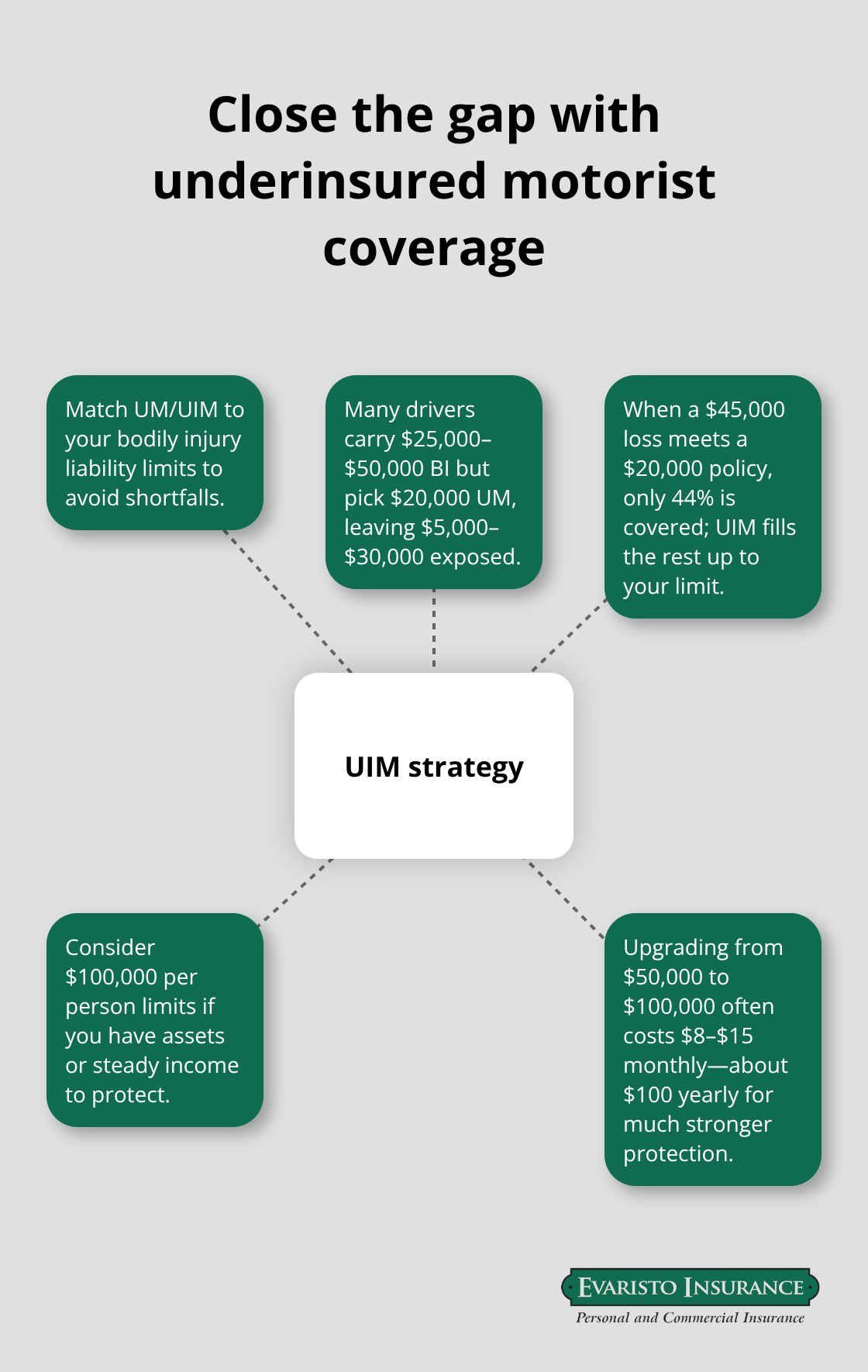
The cost difference between $50,000 and $100,000 uninsured and underinsured motorist coverage typically ranges from $8 to $15 monthly-roughly $100 annually for substantially increased protection. That’s exceptionally cheap insurance against financial catastrophe.
When to Review and Update Your Coverage
Your coverage review should happen annually or after major life changes. If you married, had children, or purchased a home in the past year, your financial obligations expanded, meaning your need for uninsured motorist protection grew proportionally. Connecticut’s weather hazards-heavy snow, nor’easters, and occasional hurricanes-increase crash frequency during specific seasons, making adequate coverage non-negotiable year-round. Document your decision in writing once you select your limits; this protects you if a dispute arises later about what coverage you actually chose.
Final Thoughts
Uninsured motorist coverage importance boils down to this: Connecticut roads expose you to drivers without insurance every single day, and your policy must protect you when theirs doesn’t. Medical bills, lost wages, and long-term care costs from a serious crash exceed $50,000 or more, leaving you with debt that damages your credit for years. Setting your uninsured and underinsured motorist limits equal to your bodily injury liability limits costs roughly $100 annually but prevents protection gaps that could cost you tens of thousands.
Pull out your current auto insurance declarations page and verify your uninsured motorist limits right now. Most Connecticut drivers carry inadequate coverage without realizing it, and if your limits sit below $50,000 per person, you’re underprotected given the state’s dense traffic corridors and constant exposure to out-of-state drivers. Calculate what you’d actually lose in a serious crash by adding potential medical expenses, lost wages during recovery, and ongoing care costs-that number should guide your coverage selection.
We at Evaristo Insurance have served Connecticut families for decades, comparing multiple top carriers to deliver tailored protection and competitive pricing. Contact us to review your current policy and ensure your uninsured motorist coverage protects your financial security on Connecticut roads.
Disclaimer: This blog post is for general informational purposes only and does not represent actual coverage, policy terms, or legal requirements. Insurance details vary by individual and jurisdiction. Please consult a licensed insurance professional for advice specific to your situation.

