
Business Property Insurance: Protecting Your Day-To-Day Assets
Your business assets represent years of investment and hard work. A single fire, storm, or theft can wipe out everything you’ve built.
Business property insurance protects what matters most-your building, equipment, inventory, and income stream. We at Evaristo Insurance help Connecticut business owners understand exactly what coverage they need and why it matters for their operation.
What Your Business Property Insurance Actually Covers
Building Structure and Physical Assets
Business property insurance protects the physical assets that keep your operations running: your building structure, equipment, machinery, inventory, and the income you lose when a covered event forces you to shut down temporarily. Hartford customers pay about $1,605 per year on average for commercial property coverage, though your actual cost depends heavily on your location, building construction, safety features, and what you’re protecting. The policy covers both owned and leased spaces, which matters whether you own your building outright or rent commercial space. Standard policies protect against fire, burglary, theft, wind, lightning, and other specified causes of loss.
What Standard Policies Don’t Cover
What often surprises Connecticut business owners is what doesn’t get covered: damage from customers dropping equipment, employee negligence during operations, vehicle accidents during deliveries, or flood damage. If you operate in a flood-prone area or store high-value equipment, you’ll need separate endorsements or additional policies to close those gaps. Replacement cost value is the right way to insure your property because it pays what it actually costs to rebuild or replace damaged items at today’s prices.
Valuing Your Property Correctly
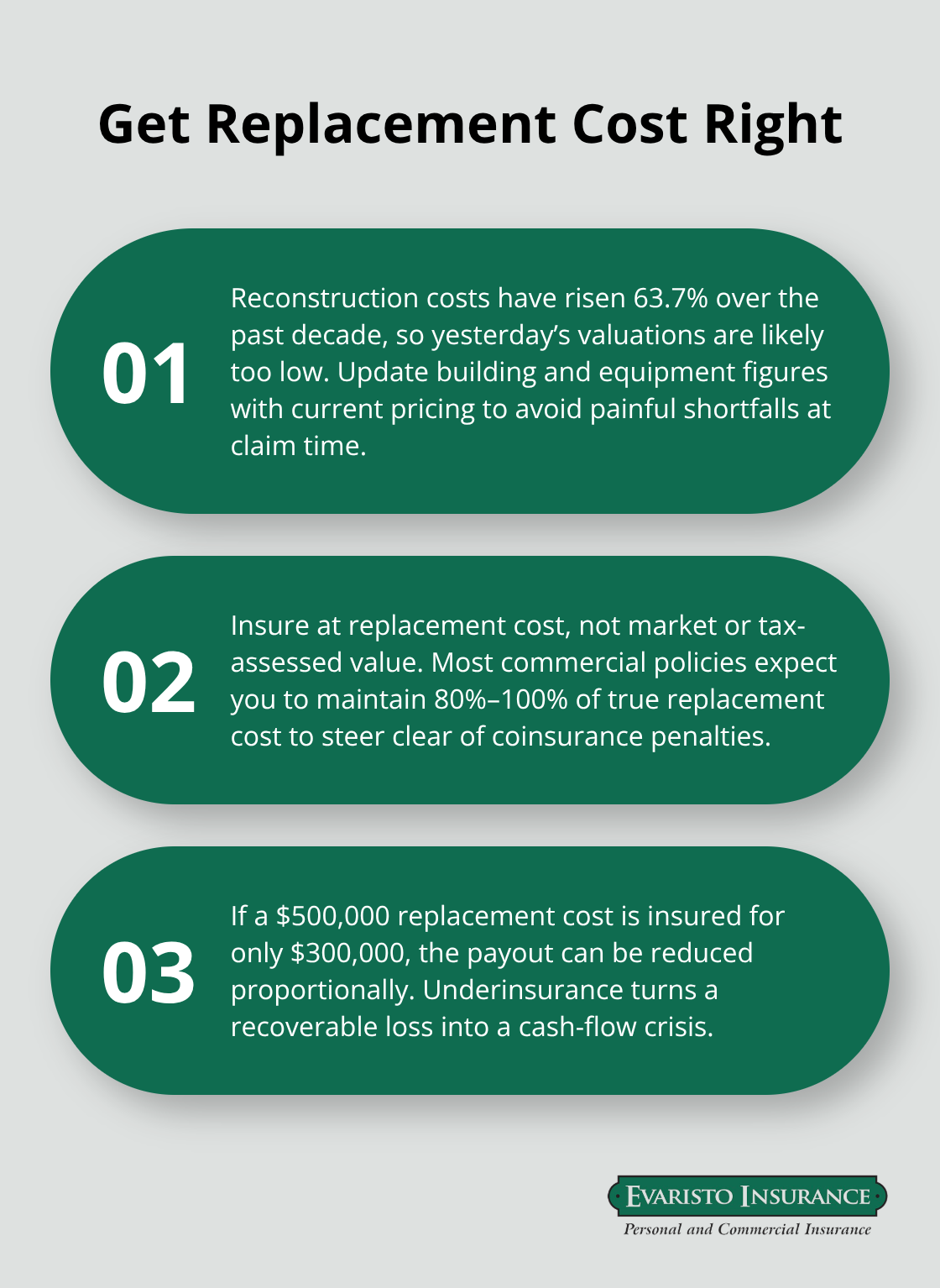
Many Connecticut businesses underestimate their replacement costs and end up with insufficient coverage; reconstruction costs have risen 63.7% over the past decade, so a building you valued five years ago may cost significantly more to rebuild today. You need to insure at replacement cost rather than market value or tax-assessed value, and most commercial policies require you to maintain coverage equal to 80 to 100 percent of your property’s replacement cost to avoid penalties when you file a claim. If your actual replacement cost is $500,000 but you only insure for $300,000, the insurer may reduce your payout proportionally.
Business Interruption Coverage Protects Your Bottom Line
Business interruption coverage is where property insurance becomes genuinely valuable for your bottom line. This coverage replaces lost net income, mortgage or lease payments, taxes, and payroll when a covered property loss forces you to temporarily halt operations. A restaurant fire that closes you for three months doesn’t just cost you the building repairs; it costs you the revenue and ongoing expenses you still owe. Without business interruption coverage, those losses come directly from your pocket.
Reducing Your Premiums Without Sacrificing Protection
Installation of monitored burglar alarms, automatic sprinkler systems, and central station fire alarms can reduce your premiums by 5 to 15 percent if your monitoring contracts stay active. Raising your deductible from $500 to $1,500 or $2,500 can cut premiums by 15 to 20 percent if you have at least two years of clean claims history and enough cash reserves to cover the higher amount. Update your property schedule and asset values at every renewal; stale schedules create under- or over-insurance problems that take only 15 to 30 minutes to correct but can save or cost you thousands at claim time. Once you understand what your property actually costs to replace and what gaps exist in standard coverage, the next step involves selecting the right coverage limits and working with someone who knows Connecticut’s specific risks and requirements.
Why Connecticut Businesses Face Real Threats to Their Assets
Weather and Natural Disasters Strike Hard
Connecticut’s business environment exposes your operation to specific, measurable risks that standard liability coverage simply doesn’t address. Connecticut experiences an average of 20 to 25 tornadoes annually across New England, with severe thunderstorms producing hail and straight-line winds that damage roofs, windows, and inventory year-round. The National Weather Service data shows Connecticut faces significant wind damage during nor’easters and tropical systems, particularly affecting coastal and central regions where many small businesses operate. A winter storm can damage your roof and force temporary closure within hours, leaving you vulnerable to secondary losses.
Fire Remains Your Biggest Single Threat
Fire remains the leading cause of property loss for commercial buildings nationwide, and Connecticut’s mix of older commercial structures and newer facilities means your replacement cost exposure is substantial. Your building sits exposed to ignition hazards from electrical systems, equipment malfunction, and external sources. A single fire can destroy your entire operation-structure, equipment, and inventory-in minutes. Smoke damage spreads far beyond the fire itself, contaminating products and rendering spaces unusable even when flames don’t reach them.
Theft and Vandalism Target Small Businesses
Property crimes in Connecticut have declined in recent years, with state crime data showing a 2% reduction in property crimes between 2020 and 2021. However, small businesses still account for a disproportionate share of theft and burglary losses because they often lack the security infrastructure of larger corporations. Criminals target businesses during off-hours when you can’t monitor your property. A break-in costs you not just the stolen merchandise but also emergency repairs, cleanup, and lost business while you restore operations.
How Property Insurance Protects Your Assets
Standard property insurance addresses these specific hazards directly. Fire and smoke damage coverage protects your building structure, equipment, and inventory from ignition and smoke infiltration-losses that can total hundreds of thousands of dollars in a single incident. Theft and vandalism coverage compensates you when criminals target your business, covering both the stolen property and damage from forced entry or destruction. Weather-related damage coverage addresses wind, hail, and water damage from storms, protecting against the seasonal threats Connecticut businesses face.
The Real Cost of Going Without Coverage
The cost to ignore these risks far exceeds the premium you pay for protection. A manufacturing business loses $50,000 in equipment to a fire; without business interruption coverage, that same fire costs an additional $15,000 to $25,000 per week in lost income while you rebuild. A retail shop experiences a break-in; the $8,000 in stolen merchandise is devastating, but the $12,000 spent on emergency repairs and cleanup compounds the loss. These scenarios happen to Connecticut businesses regularly, and the owners who carried property insurance recover. Those without it face bankruptcy or forced closure. Your location, building age, occupancy type, and security measures all influence both your risk profile and your premium, so a customized approach beats generic off-the-shelf policies every time. Understanding what specific threats matter most to your operation sets the stage for selecting the right coverage limits and working with someone who knows Connecticut’s landscape.
How to Choose the Right Coverage for Your Business
Build a Complete Inventory of Your Assets
Start with a thorough inventory of your physical assets. Walk through your building with a notepad or camera and document everything: the structure itself, HVAC systems, electrical panels, machinery, tools, furniture, computers, inventory on shelves, and anything else your business depends on. Many Connecticut business owners guess at their property values and end up significantly underinsured. The Hartford’s data shows that businesses typically underestimate replacement costs by 20 to 40 percent because they confuse what they paid for an asset years ago with what it costs to replace today. A computer you purchased for $1,200 in 2019 might cost $1,500 to replace in 2026 with equivalent specs. A roof you installed for $35,000 in 2015 could run $55,000 or more now.
Get Actual Replacement Cost Quotes
Reconstruction costs have risen over 60 percent in the past decade, which is why you need actual replacement cost quotes from vendors or contractors for major assets rather than relying on memory or original receipts. For inventory, physically count and value what sits on your shelves using current wholesale or cost prices, not retail value. Many retailers make the mistake of insuring inventory at selling price rather than what they paid for it, which means they’re overinsured and paying unnecessary premiums. This approach takes time upfront but prevents significant financial gaps when you file a claim.
Choose Replacement Cost Value Over Actual Cash Value
Replacement cost coverage represents the cost to replace or repair the property at today’s prices, which is the only sensible option for Connecticut businesses. Actual cash value deducts depreciation, so a five-year-old piece of equipment worth $10,000 new might only pay out $6,000 after depreciation, leaving you short when you need to replace it. Replacement cost coverage eliminates the financial gap between what you receive and what you actually need to spend to get back in operation. Standard commercial policies require you to maintain coverage equal to 80 to 100 percent of your replacement cost to avoid coinsurance penalties, which means if your building’s true replacement cost is $500,000 but you insure for only $350,000, the insurer may reduce your payout by the underinsurance percentage at claim time.
Work with a Local Agent to Compare Quotes
A local agent compares quotes from multiple carriers with identical coverage terms, ensuring you’re comparing apples to apples on building limits, property deductibles, business interruption duration, and any endorsements your operation needs. An independent agency like Evaristo Insurance (serving Connecticut since 1989 with local offices in Ellington and West Hartford) can access multiple top carriers to deliver tailored protection and competitive pricing. This process typically takes a few hours but prevents thousands in claim time losses and premium waste. Your location, building age, occupancy type, and security measures all influence both your risk profile and your premium, so a customized approach beats generic off-the-shelf policies every time.
Final Thoughts
Business property insurance protects your building, equipment, inventory, and income stream from the specific threats Connecticut businesses face daily. The coverage you carry determines whether a fire, storm, or theft becomes a temporary setback or a financial catastrophe that forces closure. Your replacement cost must be accurate, your coverage limits must match your actual assets, and your business interruption protection must extend long enough to get you operational again.
Underinsuring by even 20 percent can trigger coinsurance penalties that reduce your payout when you need it most. The next step is straightforward: gather your property values, identify any coverage gaps in your current policy, and obtain quotes from multiple carriers with identical coverage terms. Connecticut’s weather patterns, aging commercial structures, and property crime rates create measurable exposure that generic policies often miss.
We at Evaristo Insurance have served Connecticut since 1989 as a second-generation, family-owned independent agency with local offices in Ellington and West Hartford. We compare multiple top carriers to deliver tailored business property insurance, competitive pricing, and hands-on advocacy when you file a claim. Contact us to review your current coverage or get a quote that reflects what your property actually costs to replace.
Disclaimer: This blog post is for general informational purposes only and does not represent actual coverage, policy terms, or legal requirements. Insurance details vary by individual and jurisdiction. Please consult a licensed insurance professional for advice specific to your situation.

