Rideshare Vehicle Insurance: Getting Covered While On The Road
Rideshare driving in Connecticut offers flexibility and income, but it comes with unique insurance challenges that personal auto policies don’t address. Most drivers don’t realize their standard coverage has significant gaps when they’re actively working for platforms like Uber or Lyft.
At Evaristo Insurance, we’ve helped countless Connecticut rideshare drivers find the right protection. This guide walks you through the coverage types you actually need and how to avoid costly gaps in your policy.
What Rideshare Insurance Actually Covers
Rideshare vehicle insurance fills a significant gap that personal auto policies simply don’t address. When you drive for Uber or Lyft in Connecticut, your standard auto policy treats it as commercial activity, which most policies explicitly exclude. This means that during Phase 1-when your app is on but you’re waiting for a ride-you have almost no protection if you cause an accident. Uber and Lyft do provide contingent liability coverage during this phase, but only if your personal policy denies the claim first. That’s not primary coverage; it’s a safety net with serious limitations. During Phase 2 and 3, when you actively transport passengers, the platforms provide $1,000,000 in liability coverage, which sounds substantial until you realize your personal vehicle’s collision and comprehensive damage often aren’t covered at all. A rideshare endorsement or dedicated rideshare policy closes these gaps by extending your existing coverage to apply throughout all phases of your work, from the moment you log in to when you complete your final trip.
Connecticut’s Three-Phase Framework
Connecticut regulates rideshare through Public Act No. 17-140, which creates three distinct coverage phases. Phase 0 is simple: app off, personal policy only. Phase 1 coverage activates the moment you open the app and lasts until a passenger accepts your ride. Phase 2 and 3 begin when you match with a passenger and continue until the trip ends. The state requires platforms to maintain minimum liability limits, but these minimums don’t protect your vehicle or cover all your exposure. Many Connecticut drivers assume Uber’s $1,000,000 liability limit in Phase 2 and 3 is enough, but that covers damage you cause to others, not to your car. If you carry collision coverage on your personal policy, Uber’s Phase 2 and 3 protection includes it with a $2,500 deductible. Without a rideshare endorsement, that collision coverage typically doesn’t apply during rideshare activity at all. The practical reality is that Connecticut drivers need supplemental coverage to avoid being underinsured during their busiest earning periods.
The Real Cost of Gaps
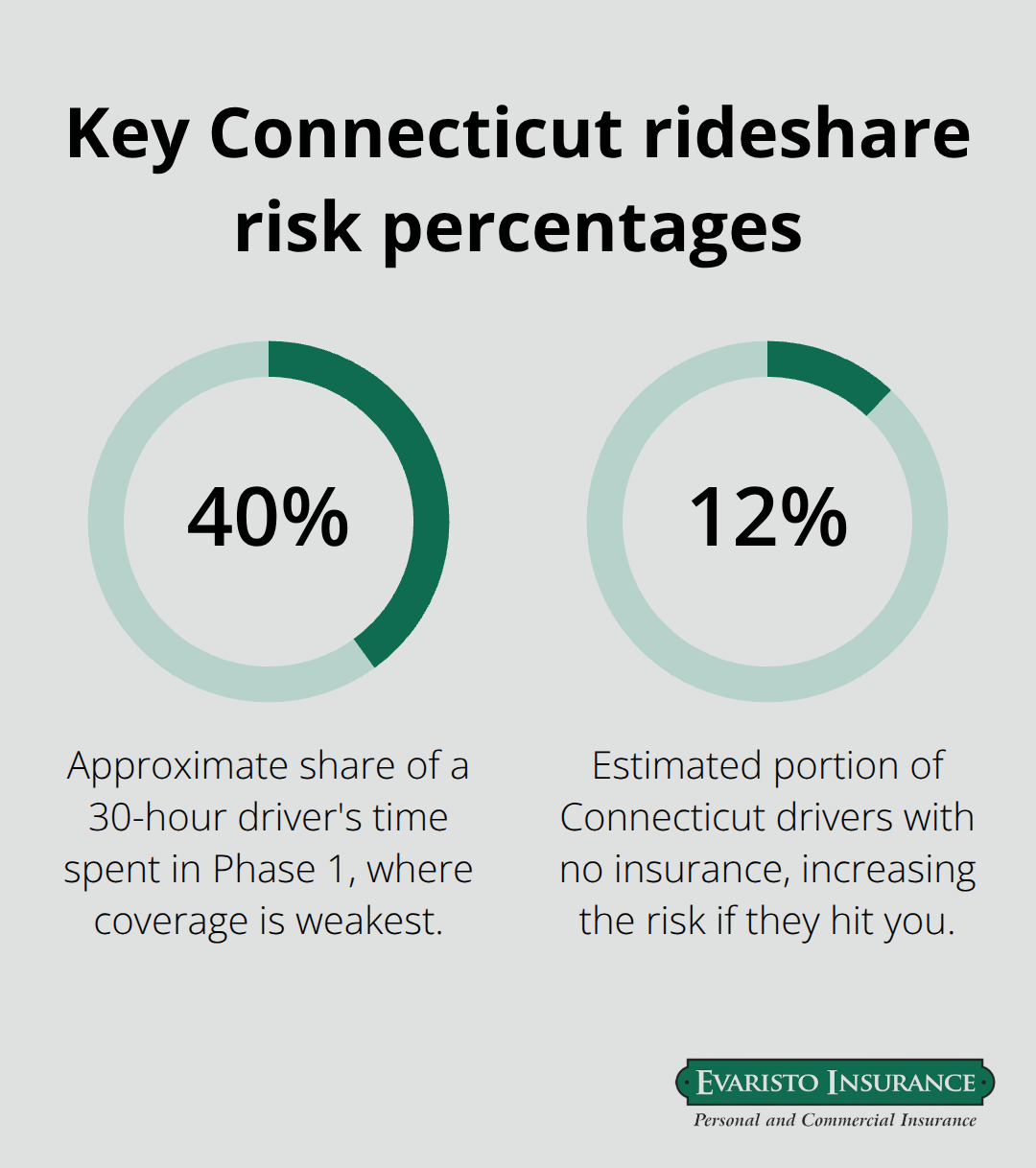
A driver who works 30 hours weekly for Uber or Lyft spends roughly 40 percent of their driving time in Phase 1, when coverage is weakest. If you cause an accident during Phase 1 and your personal insurer denies the claim because of the rideshare exclusion, the platform’s contingent liability kicks in-but with significant limits. That claim denial triggers a claims history that raises your rates.
A rideshare endorsement typically costs 15 to 20 percent more than your base premium, which translates to roughly $200 to $400 annually depending on your current coverage and location within Connecticut. That small investment eliminates the contingent coverage trap entirely and ensures your collision and comprehensive coverage applies across all phases. Without it, you’re also exposed during Phase 0 if you cause an accident immediately after you turn off the app but passengers still occupy your vehicle-a gap that has caused real disputes over who pays. Drivers who understand this framework before they start working avoid expensive claim denials and maintain cleaner driving records.
Why Coverage Gaps Matter Most During Phase 1
Phase 1 presents the highest risk because you operate in a coverage gray zone. Your personal policy excludes rideshare activity, and the platform’s contingent liability only activates if your insurer denies coverage first. This creates a delay in protection and forces you to rely on a secondary safety net rather than primary coverage. An accident during Phase 1 can result in claim denials, out-of-pocket expenses, and rate increases that compound over time. A rideshare endorsement eliminates this uncertainty by making your coverage primary from the moment you activate your app. You know exactly what protection applies, and you avoid the contingent coverage trap that leaves you vulnerable.
Moving Forward With Proper Protection
Understanding Connecticut’s three-phase framework shows why a one-size-fits-all personal auto policy fails rideshare drivers. The gaps are real, the costs of being underinsured are significant, and the solution is straightforward. The next step is evaluating which coverage options actually fit your driving patterns and income level, and how to compare carriers that offer rideshare protection without overcharging you for coverage you don’t need.
What Coverage Actually Applies When You Drive
Phase 1: The Contingent Coverage Trap
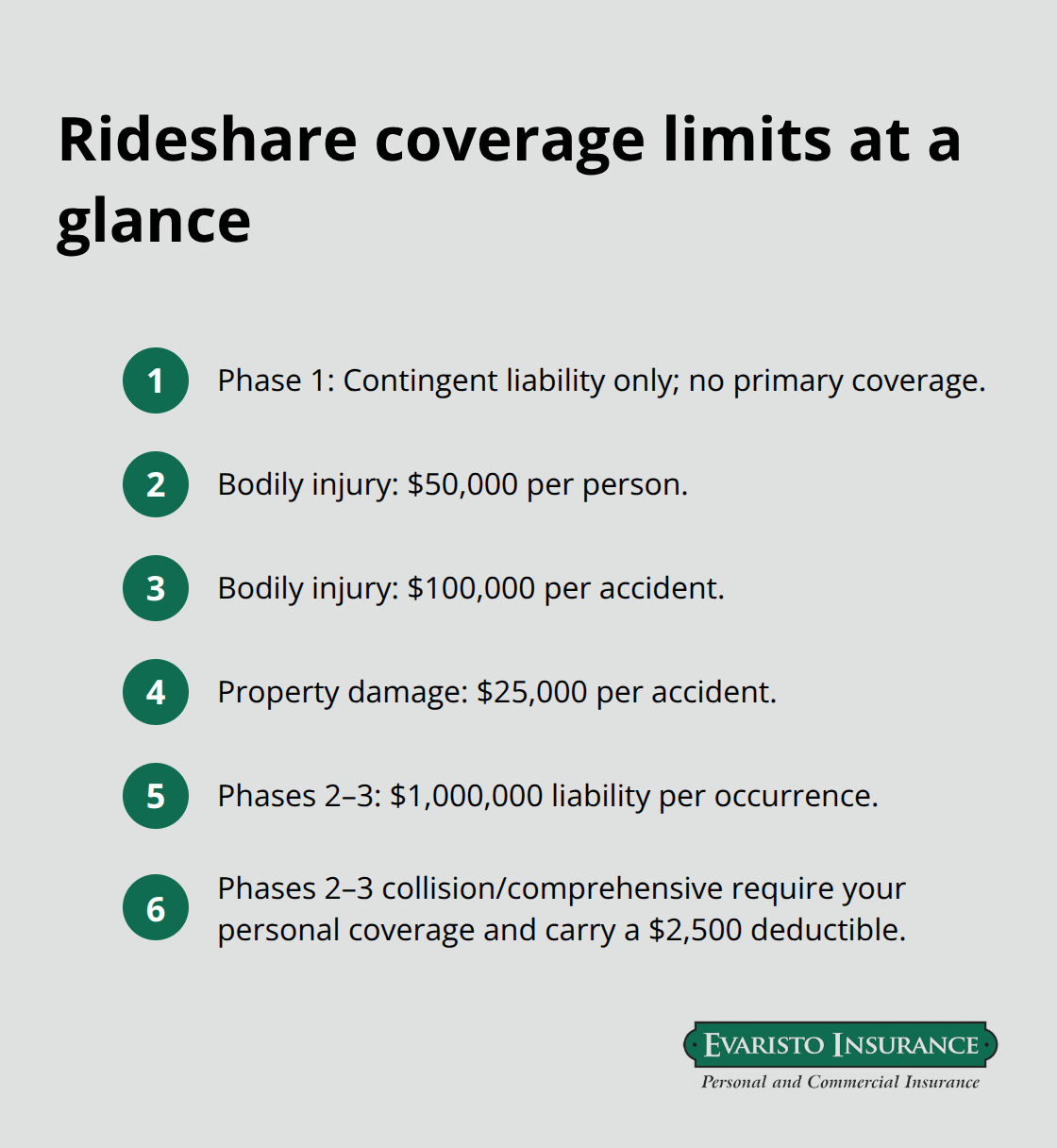
Connecticut’s three-phase framework determines which insurance pays when you work, and the differences between phases create real financial consequences. During Phase 1, when your app is active but you haven’t accepted a ride, you operate in the weakest coverage zone. Your personal auto policy excludes rideshare activity entirely, so Uber or Lyft provides contingent liability of $50,000 per person and $100,000 per accident for bodily injury, plus $25,000 for property damage-but only if your personal insurer denies the claim first.
This contingent structure means you lack primary protection; you have a backup that activates after a denial process, which delays claim resolution and creates documentation headaches. The platform covers you during this phase, but their coverage exists specifically to fill the gap your personal policy creates by excluding business use.
Phase 2 and 3: The Vehicle Coverage Blind Spot
Phase 2 and 3 coverage-which begins the moment a passenger accepts your ride-operates differently. Uber and Lyft activate $1,000,000 in liability coverage per occurrence, which satisfies Connecticut’s legal requirements and exceeds most personal auto policies. However, this massive liability limit only protects you against claims from others; it doesn’t cover damage to your own vehicle. If you carry collision or comprehensive coverage on your personal policy, Uber’s Phase 2 and 3 protection includes it with a $2,500 deductible, but this applies only if you have that coverage in the first place. The critical issue most Connecticut drivers miss is that their personal collision and comprehensive coverage typically excludes rideshare use unless they add a rideshare endorsement. You could have $500 or $1,000 in collision coverage on your personal policy, yet zero coverage for your vehicle during the busiest phases of your work.
Endorsements vs. Commercial Policies
A rideshare endorsement or dedicated rideshare policy rewrites this equation by extending your personal coverage limits to apply throughout all phases. Rather than relying on the platform’s contingent liability during Phase 1, your endorsement makes your coverage primary from the moment you log in. This costs 15 to 20 percent more than your base premium-roughly $200 to $400 annually for most Connecticut drivers-but it eliminates the contingent coverage trap and ensures your collision and comprehensive apply during Phase 2 and 3 as well. Some drivers consider a commercial auto policy instead, which provides dedicated coverage for business use without relying on personal policy extensions. Commercial policies typically cost more upfront but offer clearer coverage terms and higher liability limits if you drive frequently. The choice between an endorsement and a commercial policy depends on your driving volume; if you work 15 to 25 hours weekly, an endorsement is usually sufficient and more affordable. If you drive 30 or more hours weekly, a commercial policy often makes sense because it treats rideshare as your primary business activity rather than a side use of your personal vehicle.
Platform Differences and Coverage Consistency
Lyft follows Connecticut’s same phase-based structure with identical limits, so your coverage decision applies equally regardless of platform. The practical takeaway is that Phase 1 and Phase 2 and 3 require different protection strategies, and the platform’s insurance alone leaves your vehicle and out-of-pocket costs unprotected. Your next step involves comparing rideshare endorsement options across multiple carriers to match your driving patterns with the right coverage tier and premium, which brings you to the question of how to actually select the right policy for your situation.
How to Choose the Right Rideshare Insurance Policy
Match Your Driving Volume to Coverage Type
Choosing rideshare insurance in Connecticut requires matching your actual driving patterns to coverage options that won’t leave you overinsured or dangerously exposed. Calculate your weekly hours first: drivers working 15 to 25 hours per week typically benefit most from a rideshare endorsement added to their personal policy, while those exceeding 30 hours weekly should seriously consider a dedicated commercial auto policy. The cost difference is substantial.
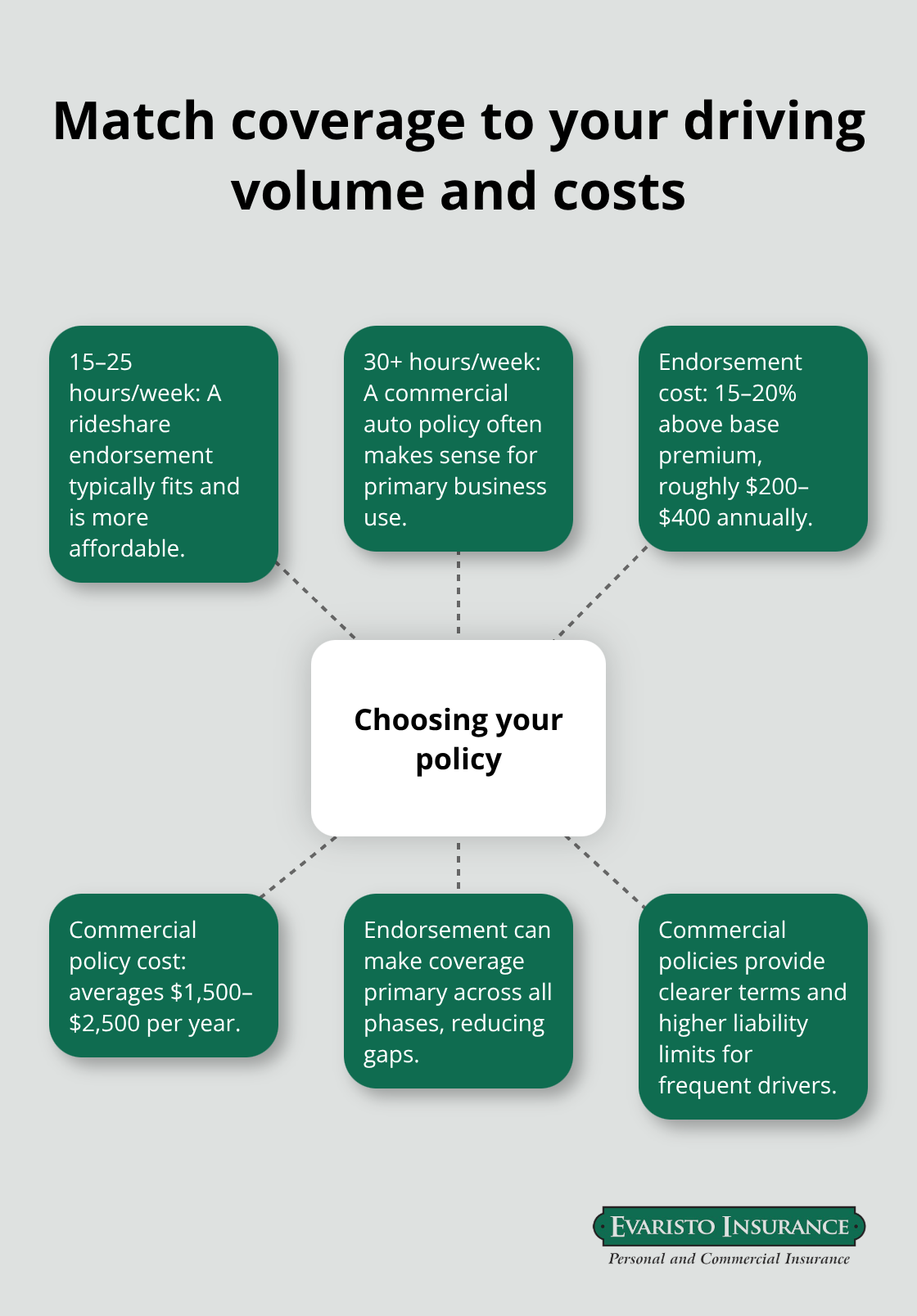
A rideshare endorsement runs 15 to 20 percent above your base premium-roughly $200 to $400 annually depending on your current coverage and location-whereas a commercial policy averages $1,500 to $2,500 per year. For occasional drivers, the endorsement makes financial sense. For serious earners, the commercial policy’s clarity and higher liability limits often justify the investment.
Request Specific Coverage Details From Carriers
When comparing carriers, don’t just look at premium quotes in isolation. Request quotes that specify Phase 1 coverage limits and whether collision and comprehensive apply during Phase 2 and 3 with a $2,500 deductible or higher. Some carriers impose restrictive limits on uninsured and underinsured motorist coverage, which matters significantly in Connecticut where roughly 12 percent of drivers carry no insurance. Verify that your potential policy covers multiple platforms if you drive for both Uber and Lyft, since some endorsements apply only to a single platform despite what sales materials suggest.
Analyze Deductibles Against Your Financial Reality
Deductibles deserve careful analysis because they directly impact your out-of-pocket costs during an accident. A $500 collision deductible sounds manageable until you realize that during Phase 1, platform contingent coverage carries no collision protection at all-meaning any vehicle damage comes entirely from your pocket unless you have a rideshare endorsement. With an endorsement, your personal deductible applies, so the choice between a $500 and $1,000 deductible becomes a straightforward math problem based on your risk tolerance and emergency savings. Request quotes at both levels and calculate the annual premium difference; if it’s under $150, the lower deductible typically wins because your repair costs exceed that threshold within three years of average rideshare driving.
Prioritize Medical and Uninsured Motorist Coverage
Medical payment coverage and uninsured motorist protection are where many Connecticut drivers undershoot. Connecticut does not mandate uninsured motorist coverage, but roughly 12 percent of state drivers carry no insurance. Your platform’s $1,000,000 liability limit protects injured passengers, not you. If an uninsured driver hits you during Phase 2 or 3, your uninsured motorist coverage pays for your medical bills and vehicle damage. A $25,000 uninsured motorist limit is insufficient for serious injuries; try for $50,000 minimum, ideally matching your liability limits. Medical payments coverage typically costs $15 to $25 annually for $5,000 in protection and should be included in any rideshare policy because platform coverage excludes your medical expenses entirely.
Work With an Independent Agent to Eliminate Gaps
An independent insurance agent who understands Connecticut’s three-phase framework can map out your specific earning patterns and accident scenarios, then recommend coverage that eliminates gaps without padding unnecessary protections. The goal is straightforward: primary coverage throughout all three phases, adequate liability and uninsured motorist limits, and deductibles that align with your financial situation. This approach prevents you from overpaying for coverage you don’t need while ensuring you’re protected during the phases when accidents cost the most.
Final Thoughts
Connecticut rideshare drivers face a straightforward choice: protect yourself properly or accept significant financial risk. The three-phase framework creates real coverage gaps that personal auto policies don’t address, and the platform’s contingent liability during Phase 1 leaves you vulnerable to claim denials and rate increases. A rideshare vehicle insurance endorsement costs 15 to 20 percent more than your base premium-roughly $200 to $400 annually-and eliminates that vulnerability entirely by making your coverage primary from the moment you log in.
Your next step requires you to calculate your weekly driving hours, then request quotes from multiple carriers that specify Phase 1 limits, collision and comprehensive coverage during Phase 2 and 3, and uninsured motorist protection at $50,000 minimum. Compare deductibles at both $500 and $1,000 levels to understand your actual out-of-pocket exposure. Verify that any policy covers multiple platforms if you drive for both Uber and Lyft, since some endorsements apply only to a single service (despite what marketing materials suggest).
We at Evaristo Insurance have guided Connecticut rideshare drivers through this process for decades. Our independent agency compares multiple top carriers to deliver rideshare vehicle insurance that matches your actual earning patterns and financial situation. Contact Evaristo Insurance to discuss your specific driving scenario and secure proper protection today.
Disclaimer: This blog post is for general informational purposes only and does not represent actual coverage, policy terms, or legal requirements. Insurance details vary by individual and jurisdiction. Please consult a licensed insurance professional for advice specific to your situation.
