

Investment Property Insurance: Protecting Your Rental Strategy
Rental properties in Connecticut generate steady income, but they expose you to risks that standard homeowners policies simply don’t cover. Tenant injuries, property damage, and lost rent during vacancies can quickly drain your profits.
At Evaristo Insurance, we’ve helped countless Connecticut landlords build investment property insurance strategies that actually protect their bottom line. The right coverage transforms your rental business from a financial gamble into a sustainable investment.
Why Your Homeowners Policy Won’t Protect Your Rental Investment
Your homeowners policy was designed for owner-occupied homes, not investment properties that generate rental income. The moment you rent out a property, your standard homeowners coverage becomes inadequate and potentially void. Most homeowners policies explicitly exclude rental activity. If you file a claim on a rental property under a homeowners policy, the insurer can deny coverage entirely, leaving you responsible for thousands in damages.
Connecticut landlords who attempt to use homeowners insurance on rental units often discover this gap only after a loss occurs. Rental property insurance exists specifically because tenant-occupied homes present fundamentally different risks than owner-occupied residences.
Why Tenants Create Different Risk Profiles
A tenant has no financial stake in protecting your property, no emotional attachment to maintaining it, and no insurance incentive to report maintenance issues before they become catastrophic. Property damage claims on rentals happen more frequently than on owner-occupied homes, and liability exposure multiplies significantly. When a tenant or their guest suffers an injury on your property, they’re more likely to pursue a lawsuit than a neighbor in an owner-occupied home would be.
Liability Claims Can Devastate Your Finances
Tenant injuries represent one of the highest-cost exposures for Connecticut landlords. A slip-and-fall injury, dog bite, or maintenance-related accident can result in medical bills exceeding $50,000 and legal costs that climb even higher if litigation follows. Without proper liability coverage, you personally defend these claims and pay settlements from your own assets.
Connecticut courts have awarded significant judgments in landlord liability cases, particularly when injuries stem from negligent property maintenance. Requiring tenants to carry renters insurance provides some protection, but it doesn’t fully shield you from liability exposure. Your landlord policy must include robust liability coverage to handle incidents that fall outside tenant responsibility or exceed their policy limits.
Loss of Rental Income: The Hidden Financial Threat
Loss of rental income coverage is non-negotiable for Connecticut investors. If a covered event like fire or storm damage makes your property uninhabitable, you lose rental income while repairs happen. Without this coverage, you still owe your mortgage while receiving zero rent.
A two-month repair period on a $2,000-per-month rental represents $4,000 in lost income that comes directly from your investment returns. This protection separates landlords who weather property disasters from those who face financial crisis. The gaps in standard homeowners policies create exposure that specialized landlord coverage addresses directly-which is why understanding what your current policy actually covers becomes your next critical step.
What Your Landlord Policy Actually Protects
Landlord insurance in Connecticut covers three distinct exposures that homeowners policies refuse to touch: the physical structure itself, injuries that occur on your property, and the income you lose when tenants cannot occupy a damaged unit. Understanding exactly what each component covers prevents the costly surprise of discovering gaps during a claim.
Property Damage Coverage Protects Your Building
Property damage coverage reimburses you for fire, wind, hail, theft, and vandalism to the building structure and permanently attached systems like plumbing and electrical wiring. This protection applies to the dwelling and other structures on the property, such as detached garages or sheds. The coverage limit dictates the maximum amount the insurer pays for a single claim. A $300,000 dwelling limit sounds substantial until you price reconstruction costs in Connecticut’s current market.
According to recent construction data, rebuilding a single-family home in Connecticut averages $150 to $300 per square foot, meaning a 2,000-square-foot rental requires $300,000 to $600,000 in coverage just to rebuild. Underestimating replacement cost creates a coinsurance penalty where the insurer pays proportionally less than your claim amount. If your property actually costs $400,000 to rebuild but you insured it for $300,000, the insurer calculates your recovery as 75 percent of the damage, leaving you responsible for 25 percent out-of-pocket.
Liability Coverage Handles Injuries on Your Property
Liability coverage handles medical expenses and legal defense when a tenant or visitor suffers an injury on your property and sues you. Connecticut courts award substantial judgments in landlord liability cases, particularly for slip-and-fall incidents and maintenance-related injuries. Standard landlord policies include $100,000 to $300,000 in liability coverage, but Connecticut’s injury awards regularly exceed these amounts.
A dog bite claim that requires hospitalization can generate $50,000 in medical costs before any pain-and-suffering damages enter the calculation. A slip-and-fall injury resulting in broken bones and permanent disability creates exposure well beyond $300,000. Connecticut landlords with multiple properties or higher-value rentals should consider umbrella liability coverage that adds $1,000,000 or more in protection above their base landlord policy. This additional layer costs $150 to $300 annually and provides critical protection when liability claims exceed your primary coverage limits.
Loss of Rent Coverage Protects Your Income Stream
Loss of rent coverage reimburses your monthly rental income if a covered peril makes the property uninhabitable during repairs. On a $2,000-per-month rental, a two-month repair period without this coverage means $4,000 in lost income that still doesn’t cover your mortgage payment. Loss of rent limits typically run 12 to 24 months of coverage, but repairs on major damage can extend beyond that timeframe. Connecticut landlords should verify that their loss of rent limit covers at least 12 months of expected rental income to protect against extended reconstruction periods.
Requiring tenants to carry renters insurance reduces your exposure but doesn’t eliminate it, particularly when guest injuries or negligent maintenance create landlord liability that tenant policies won’t cover. The gaps between what your landlord policy covers and what actually happens during a claim often emerge in the specific exclusions and conditions that most landlords overlook-which is where identifying those protection gaps becomes your next priority.
Where Standard Landlord Policies Fall Short
Even landlords with proper landlord insurance often face gaps that standard policies don’t address. Connecticut’s rental market includes scenarios that basic coverage ignores, leaving investors exposed to specific but predictable losses.
Vacancy Periods Create Coverage Blind Spots
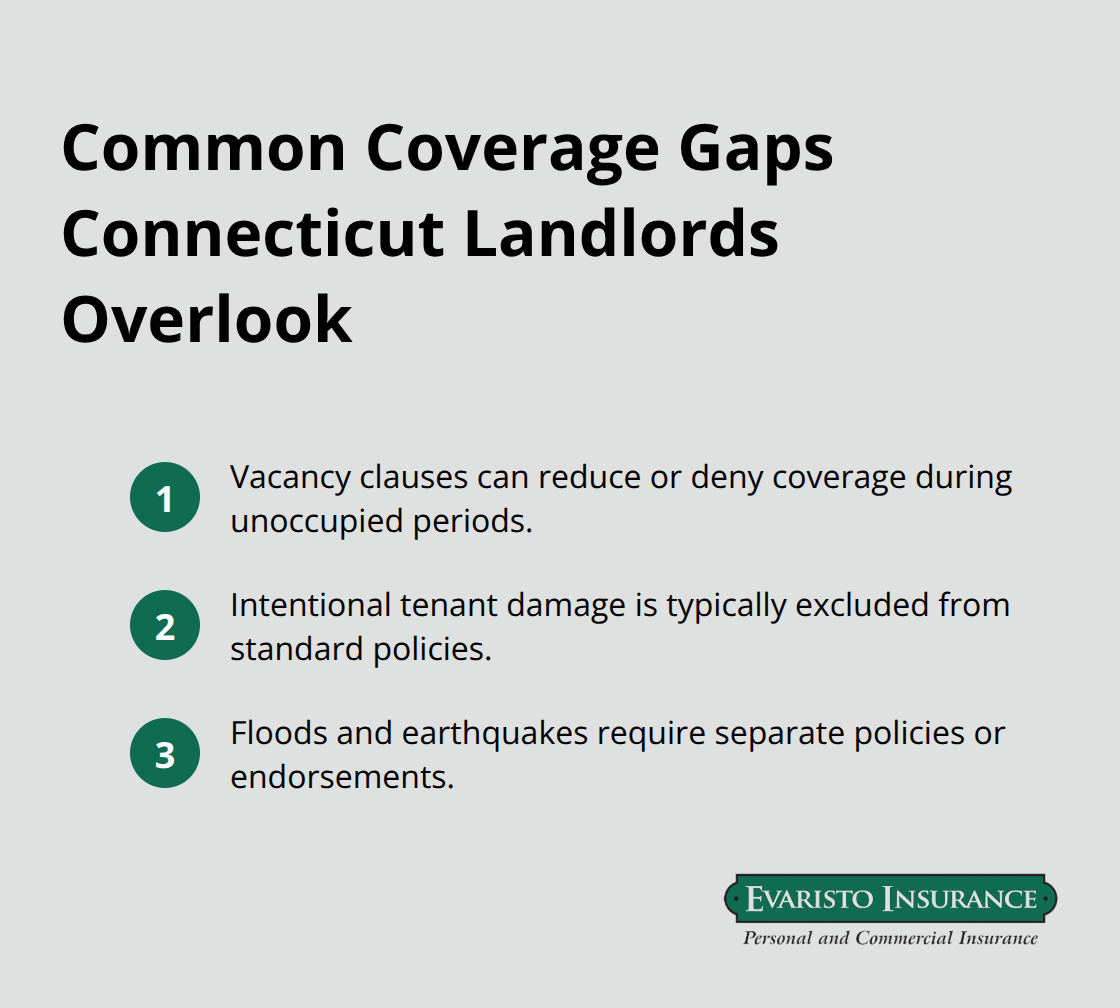
Most landlord policies require that a property remain occupied or actively marketed to maintain full coverage. If your rental sits vacant for more than 30 to 60 days, many insurers reduce coverage or exclude certain perils entirely. Connecticut’s tight rental market with 4.2 percent vacancy suggests most properties stay occupied, but extended turnover periods between tenants create a dangerous window. A fire during a vacancy between tenants often receives reduced coverage or denial if your policy contains a vacancy clause.
This gap forces Connecticut landlords to either maintain higher reserves for unexpected losses during turnover or purchase a vacant property endorsement that extends protection during unoccupied periods. The cost of a vacant property endorsement runs $50 to $150 annually and protects your investment far more effectively than gambling on quick tenant placement.
Intentional Damage Falls Outside Standard Coverage
Intentional damage by tenants sits in a gray area that catches many landlords unprepared. Your landlord policy covers accidental damage like a burst pipe or storm damage, but deliberate destruction falls into exclusions. If a tenant punches holes in walls, smashes cabinets, or damages plumbing fixtures intentionally, your insurance won’t cover repairs.
Connecticut landlords must rely on security deposits and small claims court to recover these costs, which typically recover only a fraction of actual damage. Require tenants to carry renters insurance and document the property condition with detailed move-in photos to establish baseline evidence for deposit disputes.
Natural Disasters Require Separate Coverage
Standard landlord policies exclude flood damage and earthquakes entirely. Connecticut experiences flooding from coastal storms, heavy rainfall, and river overflow, particularly in areas along the Connecticut River and coastal towns. The National Flood Insurance Program provides separate flood coverage that runs $400 to $800 annually depending on flood zone designation and coverage limits.
Earthquake coverage requires a separate endorsement despite Connecticut’s low seismic risk, because standard policies won’t cover any earthquake-related damage regardless of probability. Connecticut landlords in coastal properties and flood-prone areas must purchase flood insurance to avoid catastrophic loss, while inland investors should evaluate earthquake coverage based on specific property location and risk tolerance. These gaps don’t represent failures of landlord insurance itself but rather the reality that specialized coverages address specialized risks.
Final Thoughts
Your rental strategy in Connecticut requires protection that standard homeowners policies simply cannot provide. Investment property insurance fills the gaps between what you think you’re covered for and what actually happens when a tenant injury, property damage, or vacancy disrupts your cash flow. The difference between adequate coverage and underinsurance often determines whether a single loss becomes a manageable claim or a financial crisis that derails your entire investment plan.
Connecticut’s rental market rewards landlords who understand their exposures and address them directly. Tenant liability, property damage, loss of rental income, and natural disaster risks each demand specific coverage components that work together to protect your bottom line. Skipping any of these protections creates vulnerability that grows more expensive the longer you operate without it.
We at Evaristo Insurance have spent decades helping Connecticut landlords build rental strategies that actually work. Contact us to review your current coverage and identify the gaps that could cost you thousands-our local offices in Ellington and West Hartford provide the hands-on advocacy that transforms investment property insurance from a compliance checkbox into a strategic asset for your rental business.
Disclaimer: This blog post is for general informational purposes only and does not represent actual coverage, policy terms, or legal requirements. Insurance details vary by individual and jurisdiction. Please consult a licensed insurance professional for advice specific to your situation.

