

Investment Property Risk CT: Mitigation Strategies Through Insurance
Investment property owners in Connecticut face real exposure to weather damage, tenant disputes, and code violations. These risks can quickly drain profits if you’re not properly protected.
At Evaristo Insurance, we help local property investors build coverage strategies that actually match their exposure. The gaps in standard policies are wider than most owners realize, and they can cost you thousands when claims happen.
What Puts Connecticut Investment Properties at Real Risk
Weather Damage Threatens Your Bottom Line
Connecticut’s weather patterns create genuine exposure that many property owners underestimate. The state averages 8-10 nor’easters annually, with coastal properties facing hurricane risk during Atlantic storm season. The National Oceanic and Atmospheric Administration documented significant ice storm damage in 2022 that left thousands without power for extended periods, and winter freeze-thaw cycles accelerate foundation and pipe damage in older buildings.

Wind damage claims spike every fall, and flooding remains a persistent problem-Connecticut’s coastal areas sit in FEMA flood zones, while inland properties along rivers face their own water damage exposure.
Standard homeowner policies exclude flood entirely, leaving investors exposed to losses that can reach $50,000 or more per incident. Winter pipe bursts alone cost Connecticut property owners millions annually in hidden damage that spreads quickly through walls and basements.
Tenant Liability Claims Escalate Faster Than You’d Expect
Tenant-related liability presents a different threat that catches investors off guard. Connecticut’s strong tenant protection laws mean injury claims from guests or maintenance issues escalate rapidly, and medical payments quickly exceed $25,000 in serious incidents. A single slip-and-fall accident or injury from faulty maintenance can trigger expensive litigation that drains your reserves before insurance even enters the picture.
Code Violations Create Your Biggest Exposure
Building code violations create the most expensive exposure because Connecticut enforces strict codes around egress, electrical systems, and habitability standards. Code enforcement officers issue citations that force expensive upgrades, and if a tenant suffers injury while code violations exist, your liability multiplies dramatically. Property owners who fail to address violations face fines starting at $100 daily and potential legal action from tenants.
The combination of aging Connecticut properties and strict code requirements means code compliance costs money upfront-but non-compliance costs far more when claims happen. Insurance alone won’t protect you from code violations; you need active compliance management paired with coverage that addresses these specific Connecticut risks. Understanding what coverage actually protects you against these exposures requires more than a standard policy review.
Building Coverage That Actually Protects Connecticut Investors
Landlord Insurance Covers What Homeowner Policies Don’t
Landlord insurance in Connecticut differs significantly from standard homeowner policies, and the difference matters when claims happen. Most investors purchase policies designed for owner-occupied homes rather than rental properties, which leaves them exposed to tenant-related liability and loss of rental income. Connecticut landlord policies cover rental income loss when tenants vacate due to insured damage, protect you against liability claims from tenant guests and maintenance-related injuries, and address the unique exposure that comes with properties you don’t occupy.
The standard Connecticut landlord policy costs between $800 and $1,400 annually for a single-family rental, though multi-unit properties run higher depending on tenant turnover rates and property age. Most investors make a critical mistake by purchasing coverage limits that match their mortgage balance rather than their actual replacement cost, which leaves them underinsured by 20 to 40 percent when major damage occurs. Connecticut’s older housing stock means replacement costs frequently exceed property values, so a 1920s colonial with a $300,000 mortgage might cost $425,000 to rebuild after a fire, creating a dangerous gap in standard coverage.
Additional Coverages Address High-Risk Properties
High-risk properties require additional coverages that standard policies exclude entirely. Vacant or seasonal properties need specific endorsements because standard landlord policies exclude coverage for unoccupied buildings after 30 days, yet Connecticut investors frequently hold properties between tenants or maintain seasonal rentals without proper vacancy coverage.
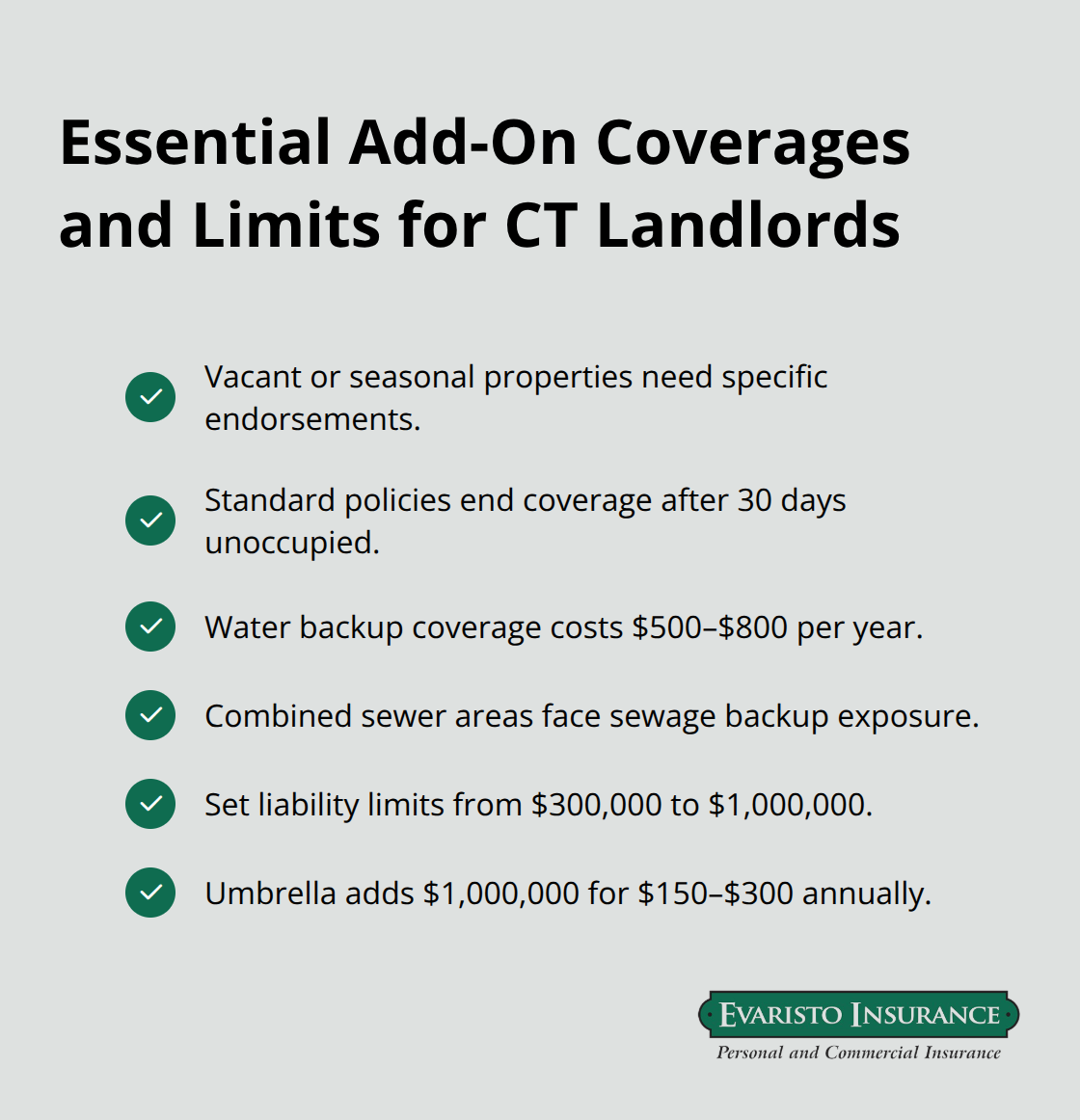
Water backup coverage costs $500 to $800 annually and protects properties in areas with combined sewer systems, addressing Connecticut’s exposure to water damage in basement areas and finished spaces.
Liability limits should start at $300,000 minimum for single-family rentals and reach $1,000,000 for multi-unit properties, because medical payment claims from tenant guest injuries regularly exceed $50,000 and litigation costs add another $25,000 to $75,000 in legal fees before any settlement. Umbrella policies provide cost-effective protection above your base liability limits, adding $1,000,000 in coverage for $150 to $300 annually, making them essential for investors holding multiple properties or high-value assets that could face exposure through a liability judgment.
Working With Local Experts Identifies Your Real Gaps
Connecticut’s specific risks (weather patterns, tenant laws, building codes) require coverage strategies tailored to your actual exposure rather than generic policy templates. An independent agency that compares multiple carriers can identify which policies address Connecticut’s water damage risk, which ones properly cover code violation liability, and which ones actually protect your rental income during extended vacancies. The right coverage structure prevents the expensive discovery of gaps when claims happen, and local expertise ensures your policy matches both your property type and Connecticut’s regulatory environment.
Where Your Connecticut Investment Property Coverage Actually Falls Short
Underinsurance Drains Your Reserves When Claims Happen
Most Connecticut property investors discover coverage gaps only after filing a claim, and by then the damage costs money from your pocket. The problem isn’t that landlord policies lack options-it’s that investors consistently purchase the wrong limits, exclude critical perils, or fail to address income loss during extended vacancies. Investors typically insure to mortgage balance rather than actual rebuild expense. A property worth $350,000 on the market might cost $480,000 to fully reconstruct after a total loss, leaving a $130,000 gap that comes straight from your reserves.
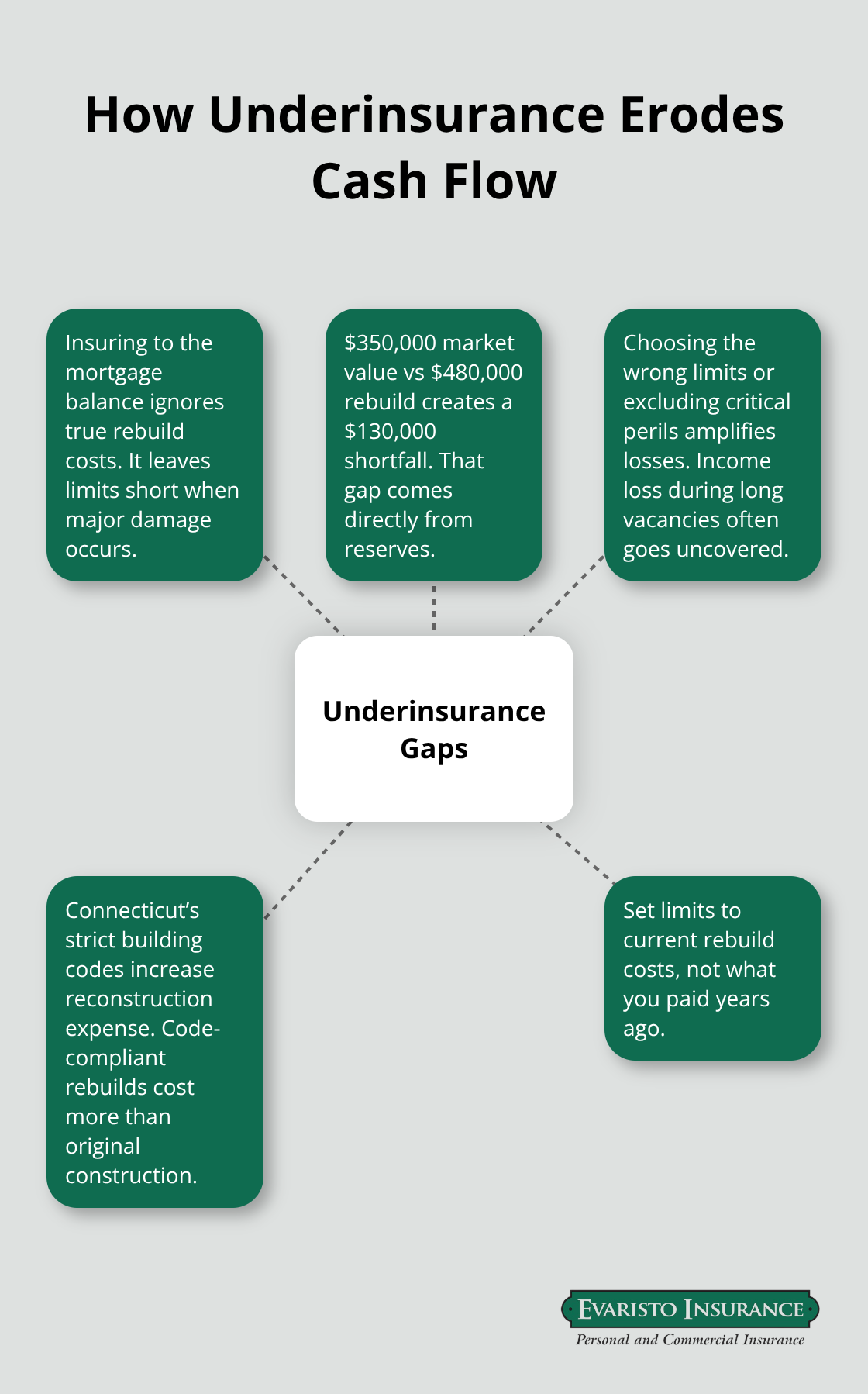
This underinsurance happens systematically because most investors base coverage decisions on purchase price rather than consulting a professional appraisal or rebuilding estimate. Connecticut’s strict building codes mean code-compliant reconstruction costs significantly more than original construction did, amplifying this gap further. Your policy limits should reflect what it actually costs to rebuild in Connecticut’s current market, not what you paid for the property five years ago.
Water Damage Exclusions Leave You Exposed
Water damage represents a massive blind spot for Connecticut investors. Standard landlord policies exclude water backup, yet Connecticut properties in combined sewer systems face genuine exposure to sewage backup that costs $25,000 to $60,000 per incident to remediate. Investors often assume their policy covers water damage because they hear the term “water” without realizing the policy excludes the specific water scenarios Connecticut properties face most frequently.
Water backup coverage costs $500 to $800 annually and protects properties in areas with combined sewer systems, addressing Connecticut’s exposure to water damage in basement areas and finished spaces. This single endorsement prevents catastrophic losses that standard policies deny outright.
Vacancy Coverage Gaps Destroy Investor Profits
Vacancy coverage gaps destroy investor profits during the periods when you need protection most. Connecticut landlord policies terminate coverage after 30 days of vacancy, yet property turnovers between tenants routinely extend beyond that window, leaving your building completely uninsured during showings, repairs, and lease negotiations. A fire in an unoccupied property voids your claim entirely, and theft or vandalism during vacancy periods get denied outright.
Rental income loss coverage, when included, typically covers only 12 to 18 months of lost rent after an insured loss, which sounds adequate until you face a major fire requiring 8 to 12 months of reconstruction on an older Connecticut building. The policy covers rent for 12 months, but construction takes 14 months-you absorb the final two months of lost income yourself. Vacancy endorsements that extend coverage during turnovers prevent this exposure from destroying your cash flow.
Reconstruction Timelines Exceed Standard Coverage Periods
Connecticut’s older housing stock requires longer reconstruction periods than standard policies anticipate. Major fire damage on a 1920s colonial property takes 14 to 18 months to complete, yet most rental income loss policies cap coverage at 12 months. You face a gap between when your policy stops paying and when tenants can actually move back in, leaving you without income while carrying mortgage payments and property taxes.
Realistic reconstruction timelines for Connecticut properties (especially those built before 1950) demand coverage limits that match actual rebuild schedules, not industry averages designed for newer construction. An independent agency that compares multiple carriers can identify which policies actually extend coverage to match Connecticut’s reconstruction reality rather than standard assumptions.
Final Thoughts
Connecticut investment property risk demands coverage that matches your actual exposure, not generic templates that fail when claims happen. The gaps we’ve covered-underinsurance, water damage exclusions, vacancy lapses, and reconstruction timeline mismatches-cost thousands in out-of-pocket losses that proper coverage prevents. Standard policies fall short because they ignore Connecticut’s specific weather patterns, tenant protection laws, building codes, and older housing stock that requires longer reconstruction periods.
Your coverage strategy must address water backup in combined sewer systems, verify that vacancy endorsements cover turnovers between tenants, and set rental income loss limits that reflect how long Connecticut properties actually take to rebuild. Most investors discover these gaps only after filing claims, which transforms preventable exposure into real money leaving your pocket. An independent agency that compares multiple carriers identifies which policies cover your specific risks and which limits match your actual replacement costs.
Contact Evaristo Insurance to schedule a policy review and confirm your investment property risk CT coverage protects your bottom line. Our local offices in Ellington and West Hartford work directly with investors to identify gaps and structure protection that prevents expensive discoveries after claims happen.
Disclaimer: This blog post is for general informational purposes only and does not represent actual coverage, policy terms, or legal requirements. Insurance details vary by individual and jurisdiction. Please consult a licensed insurance professional for advice specific to your situation.

