
Business Interruption Coverage Explained: How To Keep Your Doors Open
A single fire, flood, or supply chain failure can force your Connecticut business to close its doors-sometimes for weeks. During that shutdown, your bills don’t stop: payroll, rent, utilities, and loan payments keep coming.
Business interruption coverage explained simply means protection for your lost income when circumstances beyond your control halt operations. At Evaristo Insurance, we help Connecticut business owners understand this coverage so they’re not left vulnerable when disaster strikes.
What Business Interruption Coverage Actually Covers
Business interruption coverage pays your lost net income and fixed operating expenses when a covered event forces your business to temporarily close. This is not a theoretical safety net-it’s direct income replacement. The National Association of Insurance Commissioners found that roughly 8 million policies included business interruption coverage as of 2020, yet many Connecticut business owners remain unclear about what activates payment or what their policies actually cover. The distinction matters enormously.
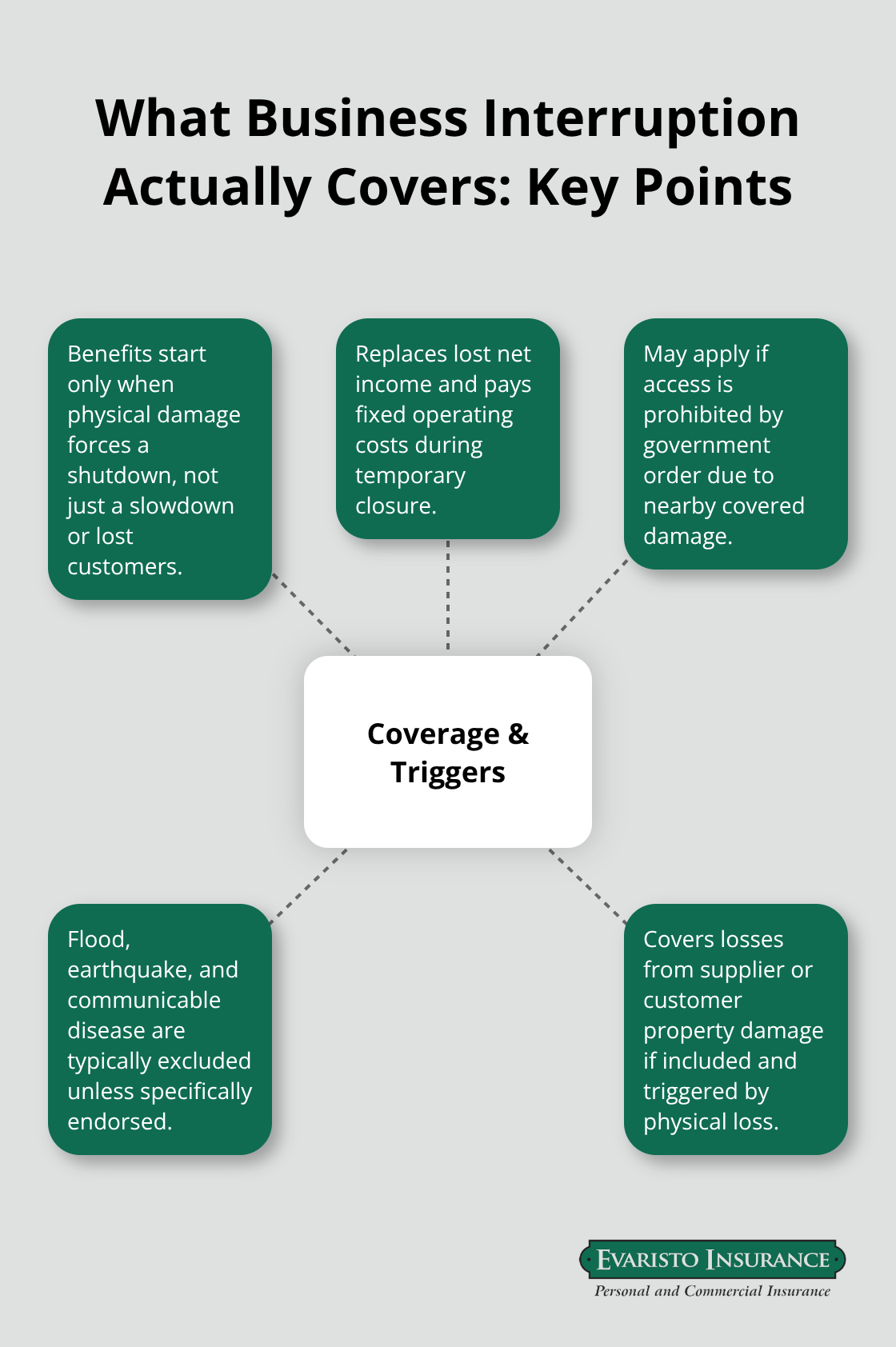
Your coverage activates only when business interruption is triggered by physical damage to property that causes the shutdown, not simply because business slows down or a customer leaves. A fire that damages your building qualifies. A nearby fire that restricts access to your location may qualify under civil authority coverage if your policy includes it. A pandemic or supply chain delay alone does not trigger standard business interruption benefits, since these typically lack the required physical loss component.
Understanding What Gets Paid During a Shutdown
When your business closes due to a covered event, this coverage reimburses mortgage or rent payments, loan repayments, employee payroll, property taxes, utilities, and other fixed costs that continue whether you operate or not. The coverage period typically begins 48 to 72 hours after the loss occurs, then extends through your restoration period-the time required to repair damage and resume normal operations. Your coverage limit determines the maximum daily or weekly payout, so underestimating this amount creates a dangerous gap. If your business loses $5,000 per day but your policy covers only $2,000 daily, you absorb the $3,000 shortfall yourself. Connecticut businesses frequently underinsure because they calculate coverage based on gross revenue rather than the actual operating expenses and lost profit that need replacement. Work backward from your financial statements to identify every fixed cost that continues during a closure, then add your typical daily net profit to that figure.
When Coverage Triggers and Common Exclusions
Your policy must clearly list the covered causes of loss-fire, wind, theft, burst pipes, and similar perils-that activate benefits. Coverage varies significantly between carriers and policy types, so review your specific policy language. Standard exclusions almost universally include flood, earthquake, and communicable disease (pandemics fall into this category). The Connecticut Insurance Department emphasizes that pandemic-related closures are not automatically covered; your policy must explicitly include virus or pandemic coverage as a rider or endorsement for those events to qualify. Civil authority coverage protects against income loss when government orders restrict access to your location due to a nearby covered event, but this requires complete prohibition of access and evidence that the order resulted from physical damage nearby. This coverage does not activate simply because a government agency issues guidance or recommendations. Contingent business interruption coverage protects against disruptions caused by damage at a supplier’s or customer’s location that affects your operations, but this too typically requires that physical damage trigger the claim.
Identifying Your Actual Coverage Gaps
Many Connecticut business owners hold multiple policies without understanding how each one applies to interruption scenarios. Your commercial property policy may include business interruption as a bundled component, or you may have purchased it separately. Some policies wrap business interruption into a broader Business Owners Policy (BOP) alongside property and liability coverage. The problem arises when you assume coverage exists without confirming the actual limits, waiting periods, and exclusions that apply to your specific situation. A licensed independent agent can review your current policies, identify what you actually have, and pinpoint gaps that leave your business exposed. This assessment becomes your foundation for selecting appropriate coverage limits and determining whether additional riders or endorsements make sense for your operation.
Real-World Scenarios Where Connecticut Businesses Stop Operating
Fire Damage Forces Extended Closure
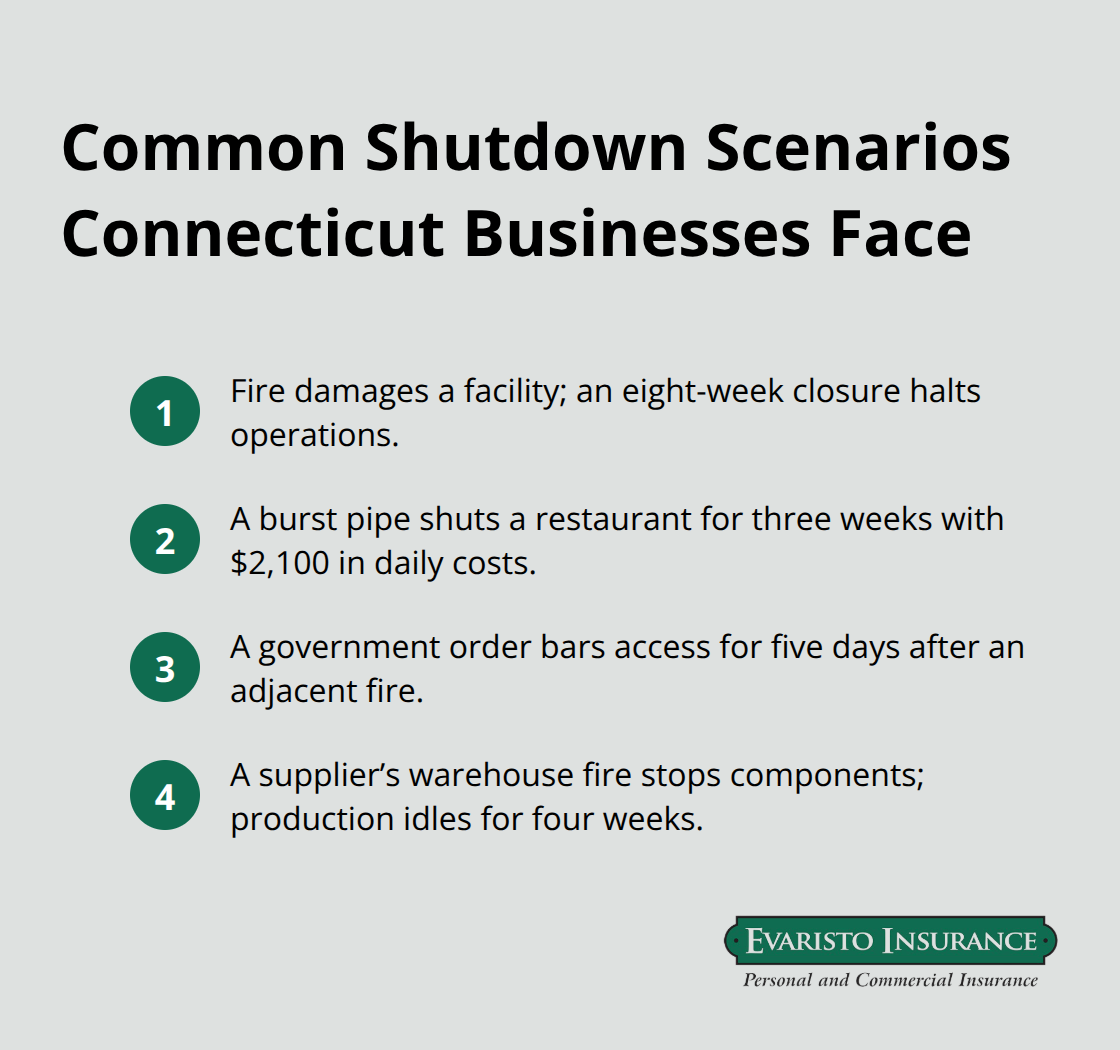
A Hartford manufacturing facility experiences a three-alarm fire that damages its production floor. Operations halt for eight weeks while structural repairs and equipment replacement occur. During those eight weeks, the owner still owes $18,000 in monthly rent, $32,000 in payroll for skeleton crew management, $4,200 in property taxes, and approximately $6,800 in loan payments. Without business interruption coverage, this owner absorbs roughly $61,000 in losses before operations resume. With appropriate coverage limits, business interruption pays these fixed expenses, allowing the business to survive the recovery period.
This scenario plays out frequently across Connecticut. A New Haven restaurant suffers water damage from a burst pipe during winter, forcing closure for three weeks while contractors repair the damage and health inspectors reinspect the facility. The owner’s daily operating costs run $2,100-roughly $1,400 in payroll for key staff, $450 in rent, and $250 in utilities and loan payments. A three-week closure without coverage creates a $44,100 gap between income lost and expenses owed. Business interruption coverage bridges exactly this gap, provided the policy includes coverage for burst pipes and the coverage limit actually reflects daily operating reality.
Government Orders Restrict Access
Civil authority coverage addresses a different but equally damaging scenario. A Stamford office building experiences a significant fire in an adjacent suite. Local fire marshals restrict access to the entire building for structural inspections, preventing all tenants from entering for five days. Your business suffered no direct property damage, yet you cannot operate. Standard business interruption does not pay because no physical damage occurred to your property. However, civil authority coverage activates when government orders restrict access due to a nearby covered event, paying your lost income during that five-day closure.
Supply Chain Failures Halt Production
Supply chain disruptions present the most complex scenario. Your manufacturing operation depends on specialized components from a single supplier located in Waterbury. That supplier’s warehouse catches fire, halting production for four weeks while they source replacement equipment and rebuild inventory capacity. Your factory sits idle-you cannot manufacture without those components. Contingent business interruption coverage protects against exactly this situation, but only if your policy includes it and only if the supplier’s loss involves physical damage. A pandemic, port closure, or shortage alone does not trigger contingent coverage.
Connecticut businesses operating with single-source suppliers face genuine vulnerability here. A licensed independent agent can assess your supply chain dependencies and recommend whether contingent business interruption makes financial sense based on your replacement supplier costs and the time required to source alternatives. Understanding these real scenarios helps you recognize which coverage gaps expose your operation to the greatest financial risk-and which protections matter most when you calculate your coverage needs.
Sizing Your Coverage to Match What Your Business Actually Loses
Start with your profit and loss statement from the past twelve months. This document shows exactly what your business spends daily to keep operating, which is the foundation for calculating business interruption coverage limits. Most Connecticut business owners make a critical mistake here: they base coverage on gross revenue rather than the actual costs that continue during a shutdown. Gross revenue is meaningless for this calculation. A restaurant generating $15,000 daily in sales might have only $3,200 in daily operating costs that need coverage during closure. The National Association of Insurance Commissioners data shows that roughly 30 to 40 percent of small businesses carry business interruption coverage, yet many of those businesses underestimate their coverage needs because they confuse sales volume with actual expense obligations.
Extract every fixed cost that continues whether you operate or not: rent or mortgage payments, property taxes, loan repayments, utilities, insurance premiums, and payroll for essential staff who maintain the business during repairs. Add your average daily net profit to this figure. If your daily fixed costs total $2,400 and your typical daily profit is $800, you need coverage of at least $3,200 daily. Connecticut manufacturers with significant equipment and inventory face particularly high restoration costs, which extends the period during which you need income replacement. A factory requiring eight weeks to repair and restart operations needs coverage that reflects eight weeks of expenses, not eight days.
Account for the Waiting Period Before Payments Begin
Your policy includes a waiting period, typically 48 to 72 hours after the loss occurs, before business interruption payments activate. This means you absorb the first three days of losses yourself. Some businesses extend this waiting period to seven or fourteen days to reduce premium costs, which works fine if you maintain sufficient cash reserves to cover that gap. Calculate honestly whether your business can absorb three weeks of expenses without income before making that tradeoff. A manufacturing operation with $50,000 in weekly expenses faces a $150,000 gap if it selects a two-week waiting period and experiences a covered loss. Most Connecticut businesses lack that cash buffer. Stick with the 48 to 72-hour standard unless your financial position genuinely allows for longer self-insurance.
The restoration period is where business interruption coverage truly matters. This is the time from when the loss occurs until your business returns to normal operating capacity. A fire requiring eight weeks of structural repair, equipment replacement, and regulatory reinspection means eight weeks of coverage need. Your policy should specify how long this restoration period extends. Some policies limit it to a set number of weeks; others tie it to the actual time required for repairs. Longer restoration periods cost more in premium, but underestimating this timeframe creates a dangerous gap. A Waterbury construction company experiencing a warehouse fire that requires ten weeks of rebuilding but pays for only eight weeks of coverage faces a two-week shortfall.
Work with an Agent Who Understands Your Specific Operation
An independent insurance agent serving Connecticut has access to multiple carriers and can compare coverage options across different insurers. This matters because business interruption terms vary significantly between carriers. One insurer might offer a broader definition of covered perils; another might provide more favorable restoration period terms or lower waiting period options. The agent’s role is to translate your business operations into coverage language. Describe your supply chain dependencies, your typical recovery timeline after a property loss, and your monthly operating expenses in detail. A good agent asks follow-up questions: Do you have alternative suppliers if your primary source is disrupted? How long could your business operate from a temporary location? What percentage of your revenue depends on a single major customer? These questions reveal whether contingent business interruption coverage or civil authority endorsements make sense for your specific situation.
Review Your Policy Language Before You Purchase
The policy document itself contains the actual coverage limits, waiting periods, and exclusion language that governs what you receive when you file a claim. Review this language with your agent before purchasing. If your policy states that coverage applies only to direct physical damage and excludes losses from supply chain disruption, you now know that gap exists and can decide whether to purchase contingent coverage as an add-on. Many Connecticut business owners discover coverage gaps only after a loss occurs, which defeats the entire purpose of carrying insurance. Verify coverage limits in writing, confirm which perils are covered, and understand waiting periods before you sign the policy. This advance clarity eliminates surprises when your business needs the protection most.
Final Thoughts
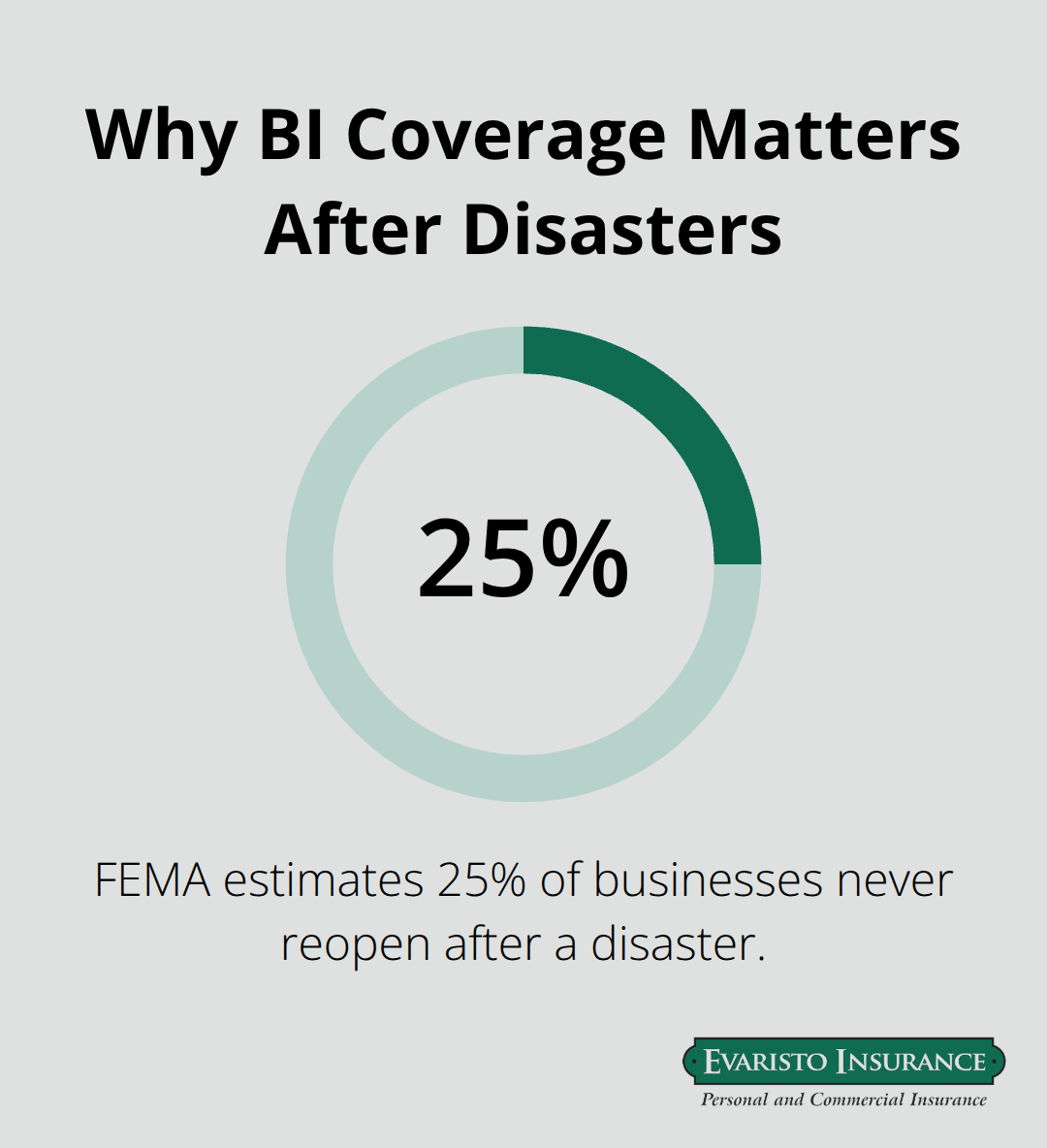
Business interruption coverage explained in practical terms means the difference between surviving a disaster and losing your business entirely. When a fire, flood, or other covered event forces your Connecticut operation to close, your expenses don’t pause-rent, payroll, loan payments, and utilities continue arriving whether you generate revenue or not. FEMA estimates that roughly 25 percent of businesses never reopen after a disaster, and business interruption coverage is the primary tool that prevents your company from becoming another statistic.
Pull your profit and loss statement and calculate your actual daily operating expenses, then add your typical daily profit to determine your coverage target. Review your current policies to identify what business interruption protection you already carry, what gaps exist, and whether your coverage limits match your real financial needs. Many Connecticut business owners discover they’re underinsured only after a loss occurs, which is too late to correct the problem.
Contact a local independent agent who understands Connecticut businesses and can assess your specific operation. We at Evaristo Insurance serve Connecticut as a family-owned agency since 1989, and we compare multiple top carriers to find coverage that actually protects your business. Reach out to discuss how business interruption coverage fits into your overall protection strategy and get a quote tailored to your operation.
Disclaimer: This blog post is for general informational purposes only and does not represent actual coverage, policy terms, or legal requirements. Insurance details vary by individual and jurisdiction. Please consult a licensed insurance professional for advice specific to your situation.

