

Home Flood Insurance Options: Is Flood Coverage Right For Your Home?
Flooding causes more property damage than any other natural disaster in the United States, yet most Connecticut homeowners don’t realize their standard insurance won’t cover it. We at Evaristo Insurance know that understanding your home flood insurance options is the first step toward real protection.
This guide walks you through what coverage actually exists, how to assess your risk, and whether flood insurance makes sense for your specific situation.
Standard Homeowners Insurance Does Not Cover Flood Damage
Your homeowners insurance protects against fire, theft, wind damage, and liability if someone gets hurt on your property. It covers the structure itself, your personal belongings, and additional living expenses if you’re displaced. What it absolutely does not cover is water damage from flooding. This distinction matters enormously because floodwater causes significant damage to homes across Connecticut. Most Connecticut homeowners discover this coverage gap only after water enters their home, which is far too late. The exclusion exists across virtually every standard homeowners policy because flood risk is geographically concentrated and difficult to price at the individual policy level.
Why Insurers Exclude Flood Damage
Flood damage operates differently than other perils. A single storm affects thousands of homes simultaneously in one area, creating catastrophic losses that would devastate an insurer’s finances. Standard homeowners policies spread risk across many different types of damage in many different locations. Flood does not work that way. When the Naugatuck River or other Connecticut waterways overflow, entire neighborhoods flood at once. Private insurers writing homeowners policies cannot absorb that concentrated risk without charging premiums so high that few people could afford them. This is why the federal government created the National Flood Insurance Program in 1968-to provide coverage that the private market simply cannot offer at reasonable rates.
The Real Cost of Going Without Flood Protection
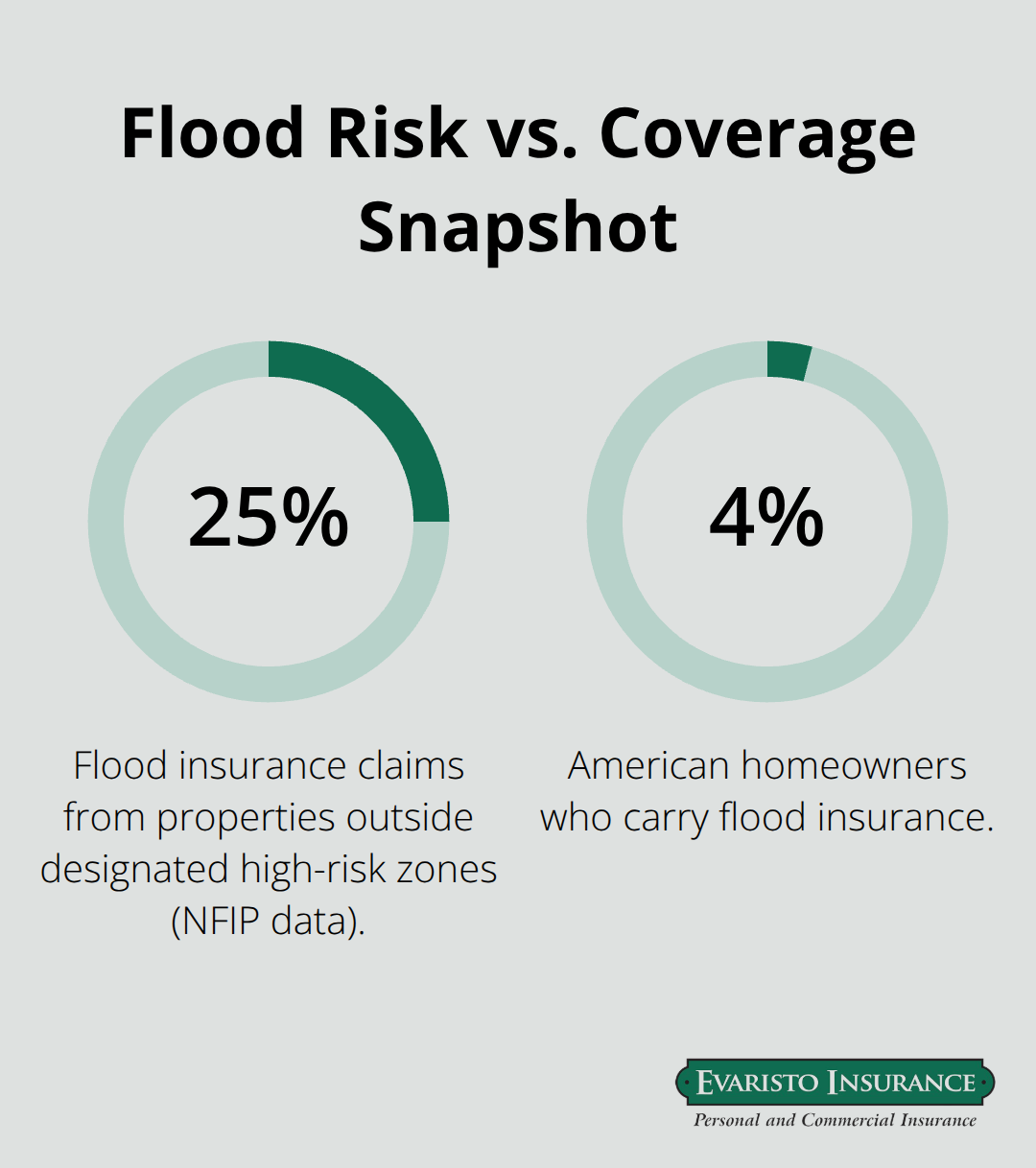
About 25 percent of flood insurance claims come from properties outside designated high-risk flood zones, according to NFIP data. This means your Connecticut home faces meaningful flood risk even if you’re not near a river or coast. Over a 30-year mortgage period, your chances of experiencing a flood are five times higher than experiencing a house fire. Yet only about 4 percent of American homeowners carry flood insurance. When your basement floods or water damages your first floor, your standard homeowners policy offers zero protection, leaving you responsible for every repair cost, every replacement, and every temporary housing expense out of pocket.
What Happens When You Need Coverage
The financial reality hits hard when water enters your home. Your homeowners insurer denies the claim. You contact your mortgage lender, only to learn that flood damage is your responsibility. Contractors demand payment upfront for water removal, structural repairs, and mold remediation. Your family may need temporary housing while repairs take months. Without flood insurance, you pay these costs entirely from savings or through loans. With flood insurance, you file a claim and receive compensation for covered losses. The difference between protected and unprotected is the difference between recovery and financial ruin. This is why understanding your flood insurance options matters before disaster strikes, not after.
Your Flood Insurance Options in Connecticut
How the National Flood Insurance Program Works
The National Flood Insurance Program covers about 4.7 million policyholders nationwide with nearly $1.3 trillion in flood coverage, making it the nation’s largest single-line insurance program. When you purchase NFIP coverage, you buy from the federal government through private insurance companies that service the policies. The NFIP offers up to $250,000 in structural coverage and separate contents protection, with deductibles typically ranging from $500 to $5,000 depending on your chosen level. The program operates in 22,600 participating communities across the country, including throughout Connecticut, and it’s delivered through more than 47 private insurers plus NFIP Direct.
If you have a government-backed mortgage in a high-risk flood zone, your lender requires you to carry flood insurance, and the NFIP traditionally served as the primary source for that coverage. However, the NFIP expired on September 30, 2025, halting new policies and renewals until reauthorization. This expiration creates significant uncertainty for Connecticut homeowners who seek traditional federal flood coverage.
Private Flood Insurance Alternatives
The private flood insurance market has grown roughly 20 percent annually since 2020, and this growth accelerated dramatically after the NFIP’s recent expiration. Private flood policies often provide higher coverage limits than the NFIP’s $250,000 cap, sometimes reaching $1 million or more-a substantial advantage if your Connecticut home has significant replacement value. Many private carriers now offer more flexible coverage options, including higher contents limits and basement protection that NFIP policies restrict.
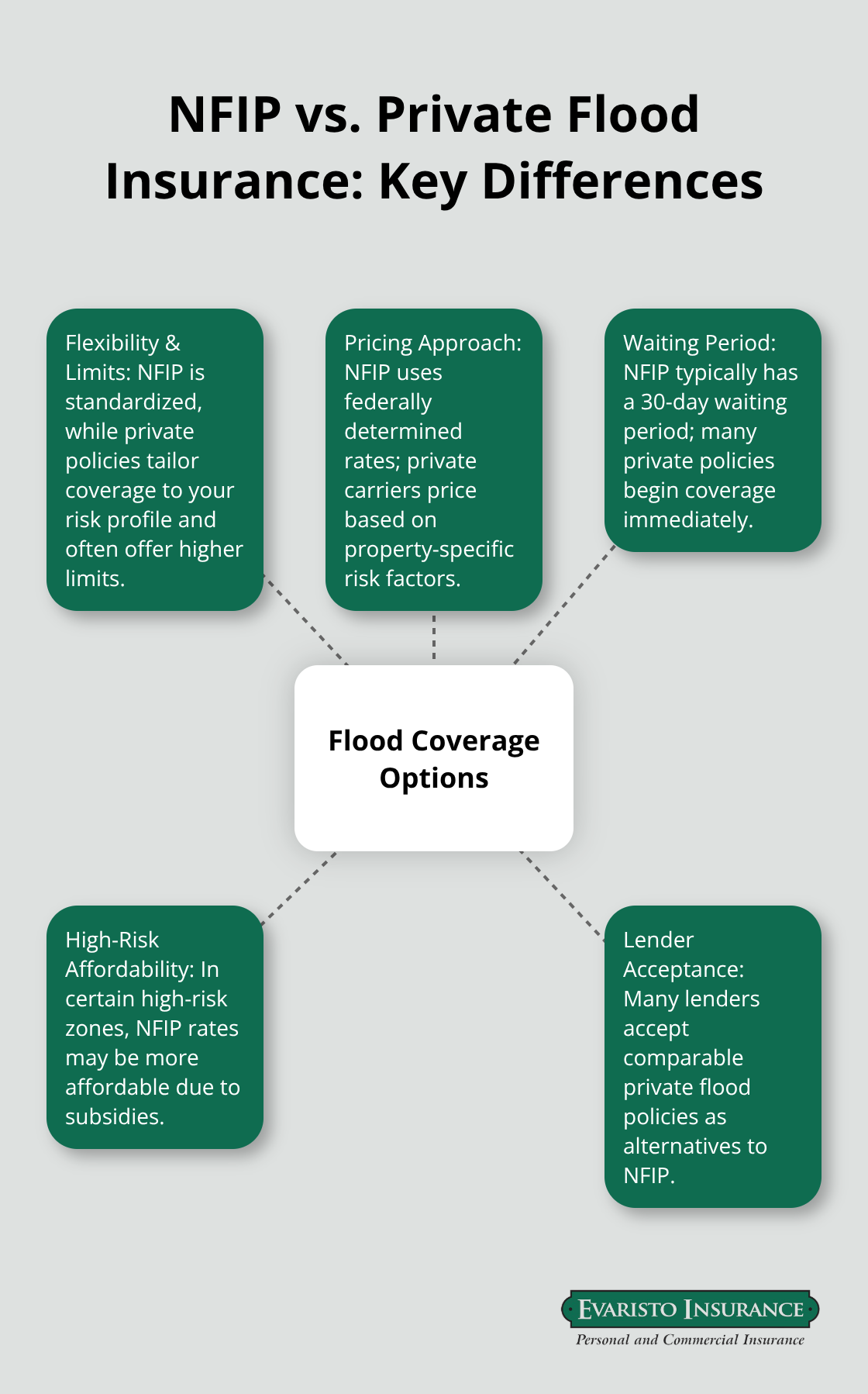
Lenders increasingly accept comparable private flood policies as acceptable alternatives to NFIP coverage, giving homeowners legitimate options beyond the federal program. Private policies typically have no waiting period, unlike the NFIP’s standard 30-day waiting period, meaning coverage begins immediately upon purchase. The private market charges premiums based on individual property risk assessment rather than FEMA flood zone designations, so your premium reflects your specific location, elevation, and loss history more precisely than federal pricing.
Comparing Your Coverage Options
The key distinction between NFIP and private flood insurance lies in flexibility and speed. NFIP coverage provides standardized protection at federally determined rates, while private policies adapt to your specific risk profile and offer higher limits. If you live outside a designated flood zone, private insurers may offer more competitive rates because they assess your individual property risk rather than applying zone-based pricing. Conversely, if you live in a high-risk area, NFIP rates may prove more affordable since the federal program subsidizes coverage in certain zones.
Your Connecticut home’s characteristics matter significantly when comparing options. Properties with basements, elevated first floors, or recent flood mitigation improvements may qualify for better rates or broader coverage through private carriers. The NFIP applies standard rules across all policies, while private insurers reward specific risk-reduction measures with premium discounts. This flexibility means your actual cost and protection level depend heavily on which option you select.
Finding the Right Coverage for Your Situation
Connecticut homeowners now face a critical decision: pursue private flood insurance immediately or wait for NFIP reauthorization. Properties in high-risk zones cannot afford to wait, as lenders require coverage and the NFIP remains unavailable. Properties in moderate or low-risk areas have more time to evaluate options, but flood risk extends far beyond designated zones-about 25 percent of NFIP claims come from properties outside high-risk areas. Your decision should account for your property’s specific elevation, local flood history, and replacement value rather than relying solely on your FEMA flood zone designation.
The next step involves assessing whether your Connecticut home actually needs flood protection and determining which coverage option aligns with your risk level and budget.
Does Your Connecticut Home Actually Need Flood Insurance
Assess Your Actual Flood Risk
Deciding whether flood insurance belongs in your protection plan requires honest assessment of your property’s risk, not assumptions based on your FEMA flood zone. The reality is stark: about 25 percent of flood insurance claims come from properties outside designated high-risk areas, according to NFIP data. This means your Connecticut home could face meaningful flood exposure even if you’re nowhere near a river or coastal area. Start with FEMA’s Flood Map Service Center, which shows your property’s official flood zone designation. However, that map tells only part of the story.
Connecticut’s flood risk extends far beyond traditional floodplain boundaries. Heavy rainstorms, poor drainage infrastructure, and aging storm sewers create localized flooding in neighborhoods that FEMA classifies as low or moderate risk. Talk to your town’s planning and zoning office or check historical flood records for your specific street or neighborhood. Ask neighbors whether water has entered their basements during heavy rain. Contact local contractors who handle water damage restoration and ask which Connecticut neighborhoods they service most frequently. These conversations reveal patterns that FEMA maps often miss.
Evaluate Your Property’s Elevation and Drainage
Your property’s elevation matters significantly. Homes with basements face substantially higher flood risk than elevated structures, particularly in areas with poor drainage or near streams that don’t appear on official flood maps. If your home sits in a low point where water naturally collects during storms, your actual risk exceeds what your FEMA zone suggests. Properties near any body of water-even small streams or retention ponds-warrant serious consideration of flood coverage.
Calculate the Cost-Benefit Analysis
One inch of floodwater causes over $25,000 in damage on average, according to industry data. Your homeowners insurance covers zero of that expense. A typical private flood insurance premium for moderate-risk Connecticut properties ranges from $400 to $800 annually for basic coverage, though high-risk properties pay substantially more and low-risk properties may pay less.
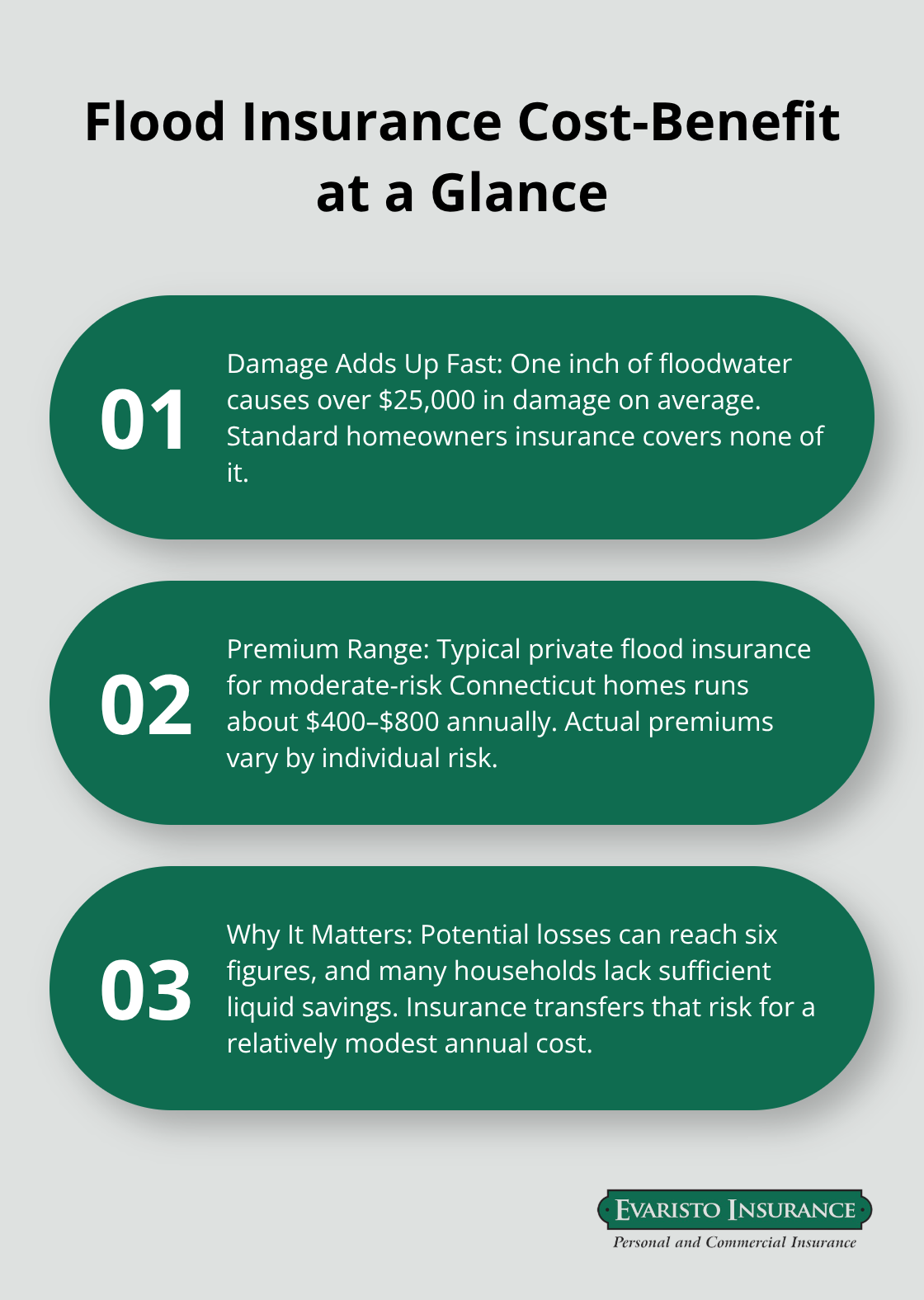
Compare that annual cost against your home’s replacement value and your financial capacity to absorb uninsured losses. If you have a $400,000 home and only $50,000 in liquid savings, flood insurance at $600 annually becomes essential protection rather than optional coverage. Conversely, if you have substantial savings and your home sits on elevated terrain with good drainage, you might reasonably self-insure. However, most Connecticut homeowners lack the financial reserves to absorb six-figure flood damage.
Understand Lender Requirements
Mortgage lenders require flood insurance if you live in a high-risk zone, removing your decision entirely. But if you’re in a moderate or low-risk area, the choice is yours. Connecticut homeowners with basements, properties near any body of water, homes in areas with documented flood history, or limited financial reserves should purchase flood coverage regardless of FEMA designation. The premium cost is negligible compared to the potential loss.
Final Thoughts
Your flood insurance decision rests on three facts: your property’s actual flood risk, your financial capacity to absorb losses, and your lender’s requirements. One in four flood claims come from properties outside high-risk areas, meaning your Connecticut home faces meaningful exposure regardless of your FEMA designation. One inch of water causes over $25,000 in damage, and your homeowners policy covers none of it-when you weigh a $400 to $800 annual premium against potential six-figure losses, protection makes financial sense.
The home flood insurance options available to Connecticut homeowners have expanded significantly with private flood policies now offering higher limits, faster coverage activation, and more flexible terms than the federal program. Your choice between private coverage and waiting for NFIP reauthorization depends on your timeline and risk tolerance. Properties with basements, homes near any body of water, and those in neighborhoods with documented flood history warrant immediate action.
We at Evaristo Insurance understand Connecticut’s unique flood risks, from river overflow to localized drainage failures that FEMA maps miss. Contact us today to assess your home flood insurance options and protect what matters most.
Disclaimer: This blog post is for general informational purposes only and does not represent actual coverage, policy terms, or legal requirements. Insurance details vary by individual and jurisdiction. Please consult a licensed insurance professional for advice specific to your situation.

