
Auto Insurance Coverage Tips Every Connecticut Driver Should Know
Connecticut drivers face real costs when they get auto insurance wrong. We at Evaristo Insurance know that understanding your coverage options-and the state’s requirements-makes a measurable difference in both protection and premiums.
This guide covers the auto insurance coverage tips you need to make confident decisions about your policy.
What Connecticut Actually Requires You to Carry
State Minimum Liability Coverage Limits
Connecticut’s minimum auto insurance requirements protect you and others on the road from financial devastation. The state mandates bodily injury liability coverage of $25,000 per person and $50,000 per accident, plus property damage liability of $25,000 per accident. These minimums sound reasonable until you face a serious collision. A single hospitalization can exceed $100,000 in medical costs alone, leaving you personally liable for amounts far beyond Connecticut’s floor. Drivers who chose minimum coverage only discover it wasn’t nearly enough when an accident happens.
Why Minimum Coverage Falls Short
Connecticut’s liability floor creates a dangerous gap between legal compliance and actual financial protection. Medical bills from a serious injury claim can reach $150,000 or more, and property damage to multiple vehicles multiplies quickly. If you cause an accident that injures two people, your $25,000 per-person limit covers only a fraction of their medical expenses. Your personal assets-your home, savings, and future wages-become vulnerable to lawsuits that exceed your policy limits. Higher liability limits cost far less than you’d expect; increasing from $25,000 to $100,000 per person typically adds only $100–200 annually to your premium.
Uninsured and Underinsured Motorist Protection
Connecticut requires uninsured and underinsured motorist coverage at the same $25,000 per person/$50,000 per accident level, and this protection matters significantly because approximately 11.8% of Connecticut drivers were uninsured in 2023. If an uninsured driver hits you, this coverage shields your medical bills and lost wages. You can purchase uninsured motorist limits up to double your bodily injury liability limit, which means you could carry $50,000 per person/$100,000 per accident if you want stronger protection.
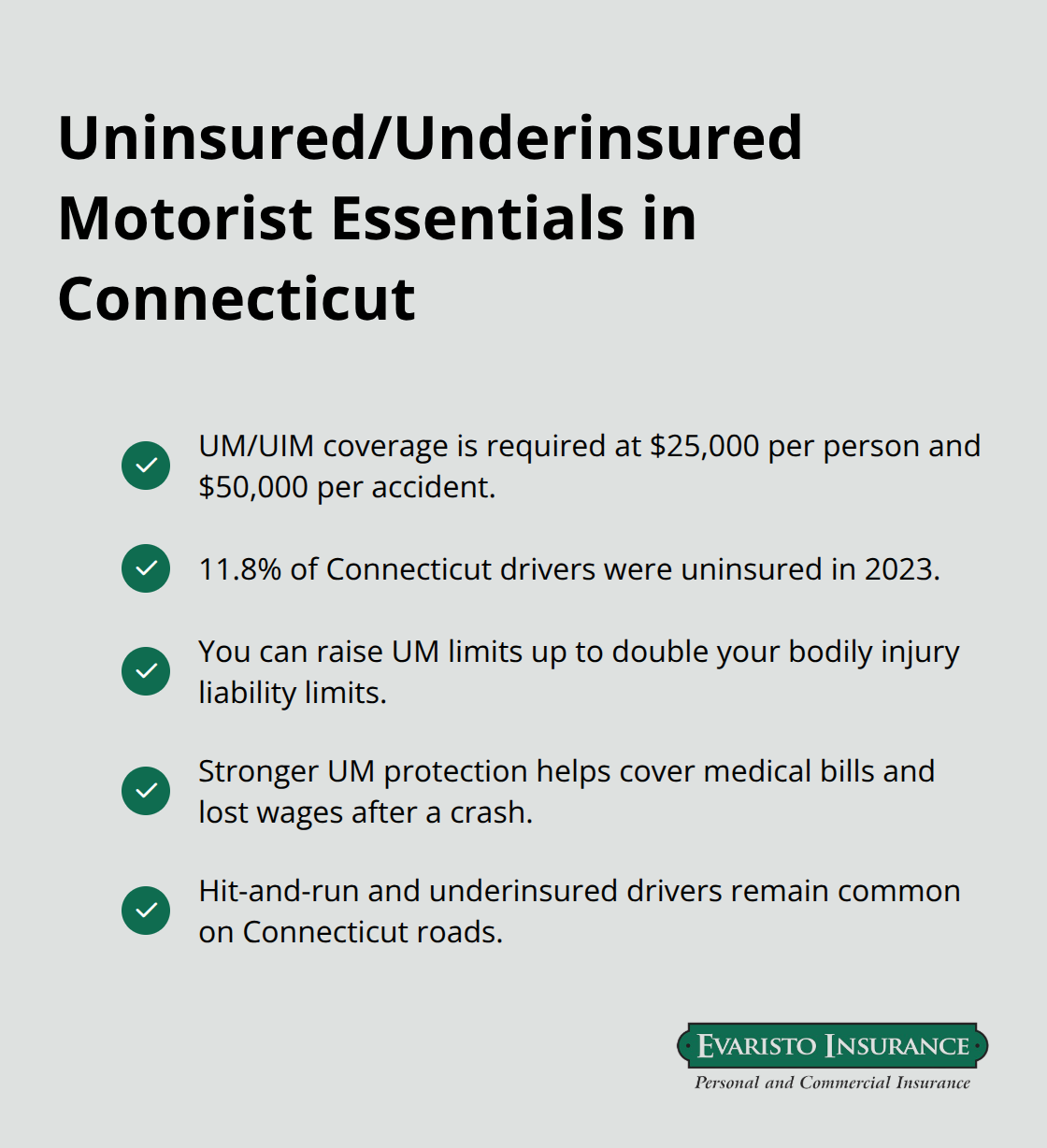
Most Connecticut drivers overlook this option, but it ranks among the smartest investments available because hit-and-run accidents and underinsured drivers remain common on Connecticut roads.
Collision, Comprehensive, and Gap Coverage
Collision and comprehensive coverage aren’t legally required, but this distinction matters less than you’d think. If you financed or leased your vehicle, your lender absolutely requires both coverages until you own the car outright. Collision coverage protects your repair costs after an accident with another vehicle or object, while comprehensive handles theft, vandalism, weather damage, and animal strikes. For vehicles under 10 years old or those with outstanding loans, skipping these coverages creates enormous financial risk.
Your deductible level directly affects your premium, so choosing a $1,000 deductible instead of $500 can lower your annual costs meaningfully, but only if you have emergency savings to cover that out-of-pocket amount when you need repairs. Gap insurance deserves consideration if you’re financing a new vehicle, since it covers the difference between what you owe and your car’s actual cash value if it’s totaled.
Connecticut’s Fault Rules and Coverage Implications
Connecticut’s modified comparative negligence rules mean that if you’re found 50% or more at fault for an accident, you cannot recover damages from the other driver, making adequate coverage even more critical for your financial protection. This legal framework shifts responsibility heavily onto your own policy to cover injuries and damages you cause. The Connecticut Insurance Department at 860-297-3900 can answer specific questions about your coverage obligations, and you should contact them if you’re uncertain whether your current policy meets state requirements.
Understanding what the law requires is just the starting point. The real question becomes whether those minimums actually protect your financial future-and for most Connecticut drivers, they don’t. Your next step involves assessing your specific situation to determine which additional coverages make sense for your vehicle, driving habits, and assets.
Matching Coverage to Your Vehicle and Driving Reality
Vehicle Age and Value Drive Your Coverage Strategy
Your vehicle’s age and value should drive your coverage decisions far more than Connecticut’s minimum requirements. A 2015 Honda Civic with 80,000 miles and a current market value around $12,000 requires a completely different approach than a 2024 vehicle financed at $35,000. For older vehicles worth less than $10,000, comprehensive and collision coverage often costs more annually than the vehicle itself, making high deductibles or even skipping these coverages financially sensible. However, if you financed or leased that vehicle, your lender will require both coverages regardless of age, which means you need to factor those mandatory expenses into your monthly budget. The real decision point arrives when you own the vehicle outright: a 2010 model with $8,000 value and a $1,000 deductible might cost $600 annually for both coverages combined, but your maximum payout after a total loss is only $7,000. That math doesn’t work, which is why we recommend dropping comprehensive and collision on vehicles worth less than 8 to 10 times your annual premium cost.
Commute Patterns and Highway Exposure Shape Your Risk
Your actual driving patterns matter more than generic risk profiles. A Connecticut driver who commutes 45 minutes each way on I-91 faces different exposure than someone who drives three miles to a local office twice weekly. High-mileage commuters should seriously consider uninsured motorist limits at the maximum allowed, since you spend hours annually in traffic where hit-and-run accidents and underinsured drivers create real financial danger. In 2023, 15.4 percent of motorists, or more than one in seven drivers, were uninsured, according to a 2025 Study by the Insurance Research Council (IRC). If you drive primarily local routes with minimal highway exposure, your risk profile shifts, though you still shouldn’t drop below the state minimum for uninsured motorist coverage.
Weather, Parking, and Comprehensive Coverage
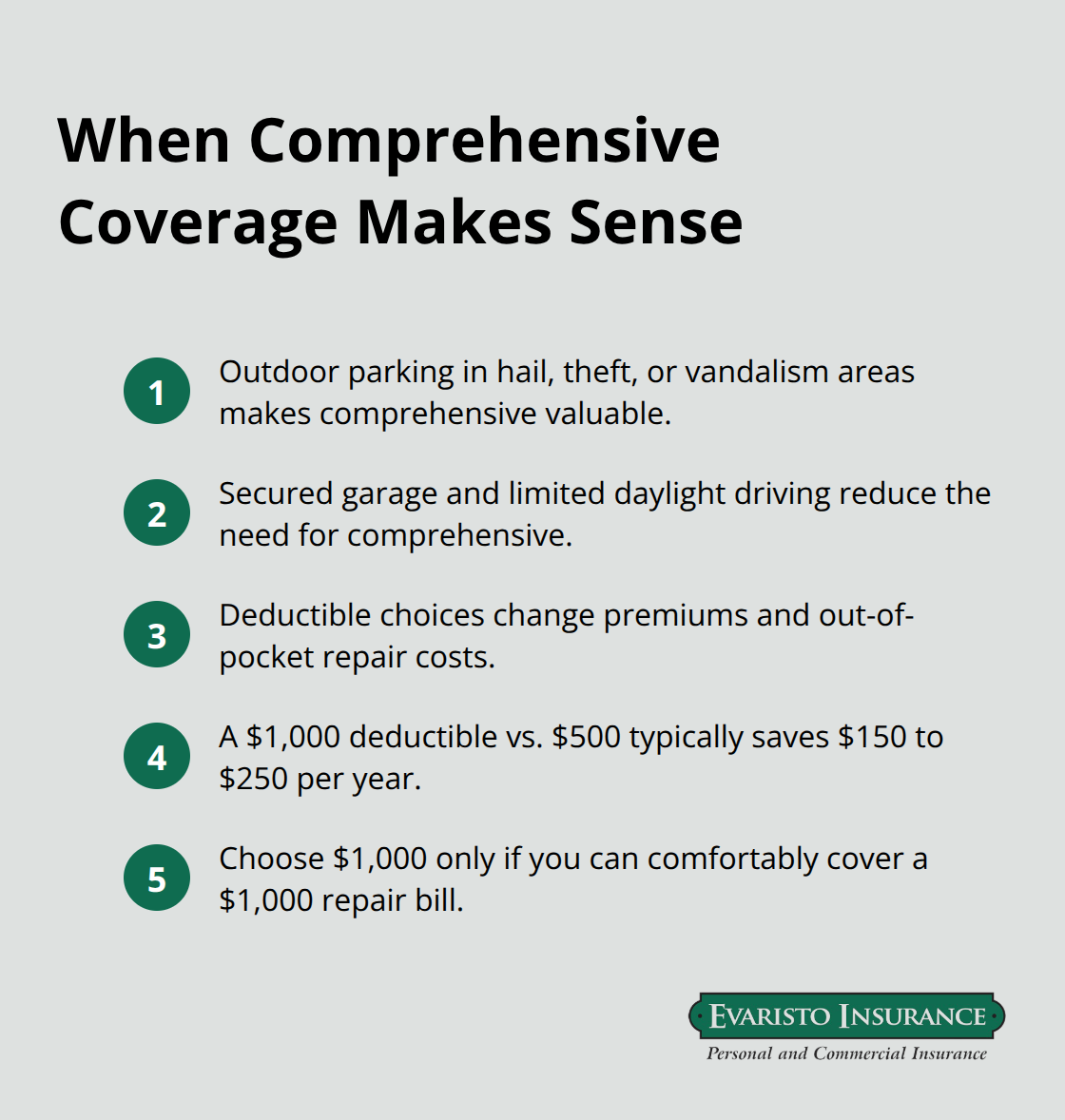
Weather exposure in Connecticut also influences your thinking: if you park outdoors year-round in an area prone to hail, theft, or vandalism, comprehensive coverage becomes genuinely valuable rather than optional. Conversely, if your vehicle sits in a secured garage and you drive only during daylight hours on familiar routes, comprehensive coverage carries less justification. The deductible choice deserves serious attention because it directly affects both your premium and your actual out-of-pocket costs when accidents happen. Choosing a $1,000 deductible instead of $500 typically saves $150 to $250 annually, but only select this option if you can genuinely cover $1,000 in unexpected repair costs without financial strain.
These vehicle and driving assessments form the foundation for your coverage choices. Once you understand what protection your situation actually demands, you can focus on the practical steps that reduce what you pay for that protection without sacrificing the coverage you need.
How to Cut Your Connecticut Auto Insurance Costs Without Sacrificing Protection
Reducing your auto insurance premium requires specific actions, not wishful thinking. Connecticut drivers leave hundreds of dollars on the table annually because they either don’t know what discounts exist or they fail to implement the changes that actually lower costs. The most effective approach combines three concrete strategies: bundling your policies, maximizing discounts tied to your vehicle and driving behavior, and maintaining a driving record that insurers reward. Connecticut drivers who apply all three strategies typically save $400 to $800 per year compared to those who take no action, though the savings vary dramatically based on your specific situation and which carriers you compare.
Bundle Home and Auto for Immediate Savings
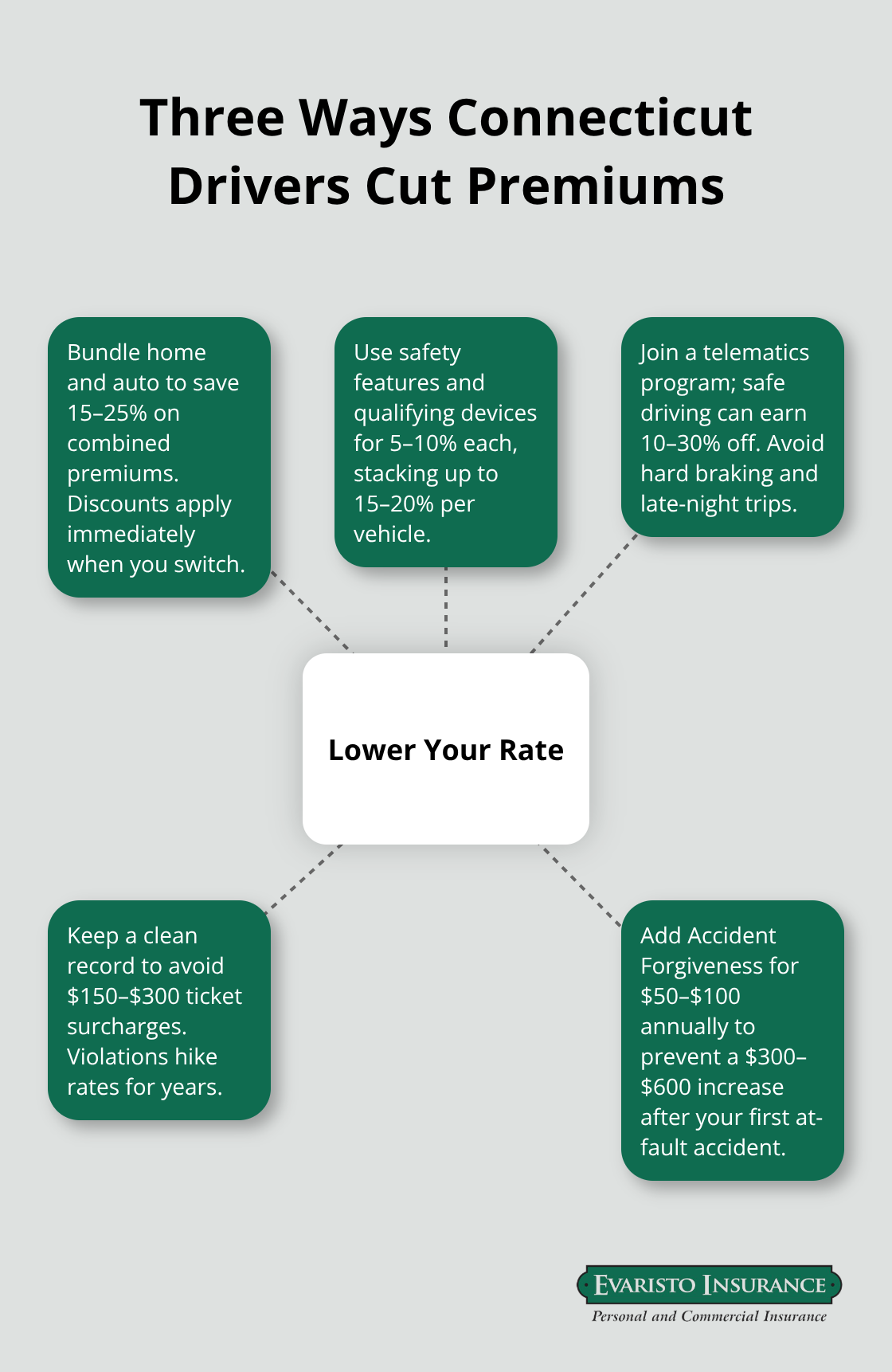
Bundling your auto insurance with homeowners or renters coverage produces the single most reliable discount available in Connecticut. Insurers offer this discount because bundled customers stay longer and generate more total revenue per household. When you bundle auto and home insurance with the same carrier, you typically save 15 to 25 percent on your combined premiums, which translates to real money on your annual bill. A Connecticut driver paying $1,400 annually for auto insurance might save $210 to $350 just from moving their homeowners policy to the same insurer. The discount applies immediately upon bundling, so the timing works in your favor if you’re shopping for either policy.
However, bundling only makes financial sense if the bundled rates remain competitive overall. Shop quotes from at least three carriers for both policies together before committing, because a 20 percent bundle discount on inflated base rates still leaves you overpaying compared to a carrier with lower starting premiums.
Leverage Vehicle Safety Features and Telematics Programs
Safety features and driving-monitoring programs create measurable premium reductions that many Connecticut drivers overlook entirely. Anti-theft devices, backup cameras, lane departure warnings, and automatic emergency braking typically qualify for discounts ranging from 5 to 10 percent depending on your insurer. If your vehicle includes multiple safety features, these discounts stack, potentially reducing your premium by 15 to 20 percent for the vehicle alone. Telematics programs like Progressive’s Snapshot or State Farm’s Drive Safe and Save offer even more aggressive savings through monitoring your actual driving behavior via smartphone. Safe drivers using these programs report discounts of 10 to 30 percent based on their real-world driving patterns, though results depend entirely on your habits. If you drive predictably, avoid hard braking, and stay off roads late at night, telematics programs reward that behavior with substantial savings. Ask your agent specifically which vehicle features qualify for discounts on your policy, then explore whether a telematics program fits your comfort level with data sharing.
Maintain a Clean Driving Record as Your Long-Term Strategy
Your driving record determines premium increases far more dramatically than any discount can offset. Insurance companies look back at several years of your driving history when determining your rates. One speeding ticket can raise your annual premium by $150 to $300 depending on the violation severity and your current rate. Accident Forgiveness, an optional benefit available from most major carriers, prevents the first at-fault accident from triggering a rate increase, and this coverage costs $50 to $100 annually while protecting you from a $300 to $600 increase. For Connecticut drivers with good records, purchasing Accident Forgiveness represents cheap insurance against a single mistake that could otherwise derail your premiums for years. If you’ve already had an accident or violation, focus on avoiding any additional incidents for the next three to five years, since your premium damage compounds with each subsequent event.
Final Thoughts
Connecticut auto insurance coverage tips ultimately rest on three practical realities: understand what the law requires, assess what your specific situation actually demands, and take concrete action to reduce costs without sacrificing protection. Connecticut’s minimum liability limits of $25,000 per person and $50,000 per accident meet legal requirements but leave your personal assets exposed to serious financial risk, while higher limits cost surprisingly little to add. Your vehicle’s age, your commute patterns, and your financial capacity to cover deductibles should drive your coverage decisions far more than state minimums ever could.
Working with a local agent transforms this information from abstract knowledge into a personalized strategy tailored to your actual situation. An independent agent compares multiple carriers simultaneously, identifies which insurers offer the best rates for your specific profile, and spots discounts you’d miss alone. They explain policy language in plain terms and advocate for you when claims arise, understanding Connecticut’s weather patterns, traffic exposure, and local risk factors in ways that national call centers cannot replicate.
Contact Evaristo Insurance to connect with an agent who will spend time understanding your situation rather than simply selling you the cheapest option available. Bring your current policy declarations page and be honest about your driving patterns, vehicle value, and financial capacity for deductibles. The difference between adequate protection and financial vulnerability often comes down to having someone in your corner who knows Connecticut insurance inside and out.
Disclaimer: This blog post is for general informational purposes only and does not represent actual coverage, policy terms, or legal requirements. Insurance details vary by individual and jurisdiction. Please consult a licensed insurance professional for advice specific to your situation.

